Why AI Literacy Matters More Than AI Tools
AI literacy is the foundation every business needs before any AI tool, platform, or strategy can deliver real value. Most organisations are not short of AI tools. They are short of people who know how to use them well, when to trust the outputs, and where the real opportunities sit.
The numbers tell the story clearly. According to DataCamp's 2026 research, 60% of enterprise leaders say they have an AI skills gap, even though the majority are already investing in AI tools. When employers do provide structured AI training, adoption jumps from 25% to 76%. That is not a marginal improvement. That is the difference between a tool sitting unused and a team transforming how it works.
Yet here is the disconnect: 42% of employees say their employer expects them to learn AI on their own. No structure, no support, no progression. Just a vague expectation that people will figure it out. That approach does not work for any other business-critical skill, and it will not work for AI either.
We speak to employers every week who have bought AI tools, subscribed to platforms, and rolled out licences, only to find that adoption stalls within a month. The tools are not the problem. The missing piece is always literacy. People need to understand what AI can do before they can use it well.
What Is AI Literacy, Exactly?
AI literacy is the ability to understand, use, evaluate, and work alongside artificial intelligence tools in a professional context. It does not mean everyone needs to code or build machine learning models. It means your people can recognise where AI adds value, use AI tools effectively in their roles, make informed decisions about AI outputs, and understand the ethical and governance considerations involved.
Think of it like digital literacy in the early 2000s. Back then, businesses needed everyone to understand email, spreadsheets, and the internet. Nobody expected the receptionist to write HTML, but they did need to know how to use a browser and send an email. Today, the equivalent is understanding prompts, automation workflows, and AI-assisted decision-making.
The challenge is that AI literacy is not binary. You are not either "AI literate" or "not." It exists on a spectrum, and different roles in your organisation need different levels of fluency. Your CEO needs to understand AI strategy and governance. Your marketing team needs to use AI tools confidently. Your operations team might need to build automations. Your data team might need to train models.
The 5 Levels of AI Literacy
To make AI literacy practical, we use a 5-level framework that gives businesses a clear picture of where their teams are now and where they need to get to. Each level builds on the one before it, and each connects to specific training and development pathways.
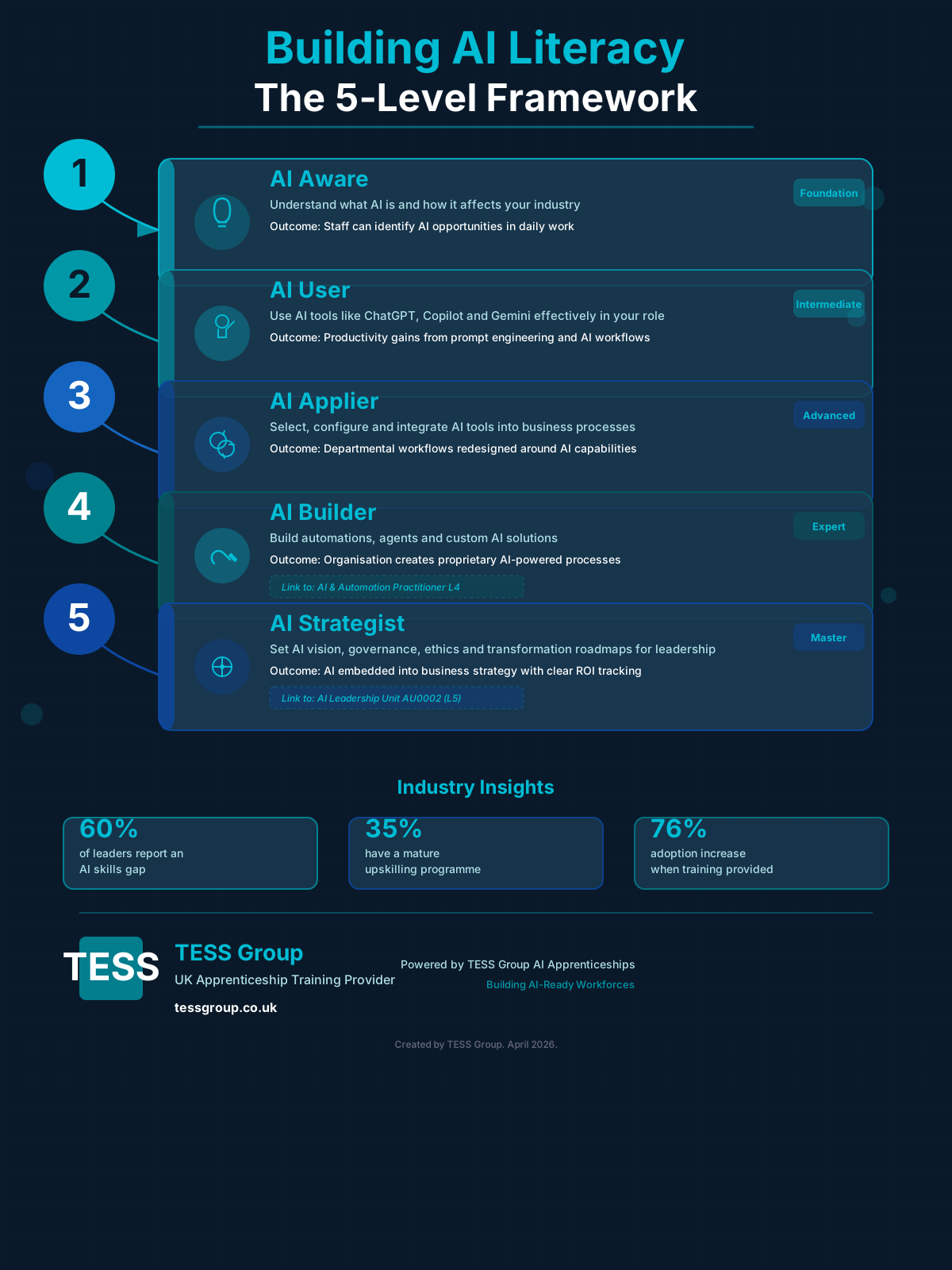
Understanding What AI Is and How It Affects Your Industry
At this level, employees understand the basics: what AI is, what it can (and cannot) do, and how it is already changing their sector. They can spot opportunities in their daily work where AI might help, even if they are not yet using the tools themselves.
Using AI Tools Effectively in Your Role
AI Users can work confidently with tools like ChatGPT, Microsoft Copilot, Google Gemini, and industry-specific AI platforms. They understand prompt engineering, can evaluate AI outputs critically, and know when to trust the result and when to verify. This is the level every employee in your organisation should reach as a minimum.
Selecting, Configuring and Integrating AI Into Business Processes
AI Appliers go beyond using individual tools. They can evaluate which AI solution fits a particular business problem, configure platforms, and integrate AI into existing workflows. They bridge the gap between the technology and the business need, making AI work within real processes rather than as a standalone novelty.
Building Automations, Agents and Custom AI Solutions
AI Builders can create the solutions themselves. They build automations, design AI agents, connect APIs, and develop custom workflows that solve specific business problems. They work with platforms like Power Automate, Make, Zapier, and increasingly with AI agent frameworks. This is where your organisation starts creating proprietary competitive advantage through AI.
Setting AI Vision, Governance, Ethics and Transformation Roadmaps
AI Strategists operate at the leadership level. They set the organisation's AI vision, design governance frameworks, manage ethical considerations, evaluate ROI, and build transformation roadmaps. They decide not just how to use AI, but where, when, and why. Research from McKinsey shows that 80% of the value from AI comes from workflow redesign and strategic deployment, not from the technology itself.
The framework gives employers a shared language for something that usually feels vague. Instead of saying "we need to upskill our team in AI," you can say "our marketing team is at Level 2 and we need them at Level 3 by Q3." That specificity changes everything. It makes AI literacy measurable, fundable, and achievable.
What Is an AI Academy?
An AI Academy is a structured internal programme that builds AI capability across your entire workforce, not just the IT team. It provides a clear progression path from basic AI awareness through to strategic AI leadership, with different learning tracks for different roles.
Rather than sending a few people on ad-hoc courses, booking one-off workshops, or hoping that a LinkedIn Learning licence will do the job, an AI Academy gives your organisation a systematic way to develop AI skills at every level. It has a curriculum, a progression path, clear outcomes, and ideally, recognised qualifications along the way.
The businesses getting the most from AI are the ones treating it like any other core capability. They have a plan, a pathway, and accountability. An AI Academy is not about creating a room full of data scientists. It is about making sure everyone in the business, from the warehouse floor to the boardroom, has the right level of AI fluency for their role.
The beauty of the AI Academy model is that it does not need to be expensive or complex. At its simplest, it is a structured progression that maps roles to AI literacy levels, identifies gaps, and provides funded training pathways to close them. And in the UK, the Apprenticeship Levy means the training can be fully funded for levy-paying employers.
How to Build Your AI Academy: A Practical Roadmap
Step 1: Assess Where You Are Now
Map your workforce against the 5-level framework. Where does each team sit today? Most organisations find the bulk of their staff at Level 1 (Aware) or Level 2 (User), with a handful of individuals at Level 3 or 4, and almost nobody at Level 5. That is not a failure. That is a starting point.
Step 2: Define Where You Need to Be
Not every role needs Level 5 AI literacy. Your customer service team might need Level 2 or 3. Your operations managers might need Level 3 or 4. Your senior leadership team needs Level 5. Set realistic targets by role, department, and timeline.
Step 3: Map Training Pathways
This is where apprenticeships become powerful. Rather than buying generic courses, you can enrol staff onto structured programmes that deliver recognised qualifications while they work. Each programme maps to a specific level in the framework:
Step 4: Fund It Through the Levy
For levy-paying employers (those with an annual payroll above £3 million), apprenticeship training is fully funded through the Apprenticeship Levy. For non-levy employers, the government co-funds 95% of the cost. Either way, building an AI Academy through apprenticeships is dramatically more cost-effective than buying external training programmes.
Step 5: Measure and Iterate
Track progress against the framework quarterly. How many people have moved up a level? Which teams are still stuck? Where are the bottlenecks? An AI Academy is not a one-off project. It is an ongoing capability programme that evolves as the technology does.
One of our clients started with six people on the Level 4 AI & Automation apprenticeship. Within nine months, those six had built automations that saved the business over 2,000 hours a year. Now they have enrolled another 14. That is how an AI Academy grows: you start with a cohort, prove the value, and scale from there.
What an AI Academy Looks Like in Practice
Here is how a mid-sized UK employer might structure their AI Academy across the 5 levels:
Finance Team: From Spreadsheets to Smart Workflows
The finance team starts at Level 1 (AI Aware). They attend foundation sessions on how AI is transforming financial processes, from automated reconciliation to predictive cash flow. Three team members enrol on the AI & Automation L4 and spend 15 months building automations for invoice processing, expense categorisation, and management reporting. The Finance Director joins the AI Leadership Pathway to set the department's AI strategy.
HR Department: AI-Powered People Operations
The HR team moves from Level 2 (AI User, already using Copilot for drafting) to Level 3 (AI Applier). Two HR managers enrol on the AI for Team Leaders L4 to learn how AI can improve recruitment screening, onboarding workflows, and employee engagement analysis. The Head of HR completes the Level 5 AI Leadership Pathway to build the department's AI governance framework and ensure responsible AI use in people decisions.
Operations: Scaling Automation Across the Business
The operations team needs to reach Level 4 (AI Builder). Two operations managers enrol on the AI for Operations Leaders L4 to understand how AI fits into process improvement and cyber security. A further four team members join the AI & Automation L4 to build the automations, agents, and integrations the business needs. Within 12 months, they have automated over 30 internal processes.
What makes the AI Academy approach work is that it is not one-size-fits-all. The receptionist and the CTO both need AI literacy, but they need very different types of it. The framework lets you have that conversation without anyone feeling left behind or overwhelmed. Everyone has a level, everyone has a pathway, and everyone can see their own progression.
The Three Mistakes Businesses Make with AI Training
Mistake 1: Jumping to Tools Without Building Foundations
Buying AI tool licences before investing in literacy is like buying a fleet of cars for a team that cannot drive. The tools sit unused, adoption stalls, and leadership concludes that "AI does not work for us." The fix is simple: build Level 1 and 2 literacy first, then introduce tools. Adoption rates triple when people understand the technology before they are expected to use it.
Mistake 2: Training Only the IT Team
AI literacy is not an IT project. The biggest gains come from business teams, such as finance, HR, operations, marketing, and customer service, who understand their own workflows and can see where AI fits. If you only train your IT team, you end up with technically capable people who do not understand the business problems and business teams who cannot articulate what they need.
Mistake 3: One-Off Workshops Instead of Structured Programmes
A half-day AI workshop creates enthusiasm. A 15-month apprenticeship creates capability. The research is clear: organisations with mature, structured AI upskilling programmes are nearly twice as likely to see strong returns. Ad-hoc training creates a spike of interest that fades within weeks. A structured programme, like an AI Academy built on apprenticeships, creates lasting change because it includes practice, assessment, and real-world application.
I have lost count of the number of businesses who tell us they "did some AI training last year" and it did not stick. When we ask what they did, it is usually a couple of webinars and a team away-day. That is not training. That is awareness. There is nothing wrong with awareness as a starting point, but it has to lead somewhere structured or it evaporates.
How TESS Group Supports Your AI Academy
At TESS Group, we have built a complete portfolio of AI apprenticeships that map directly to the 5-level AI literacy framework. From Level 3 data and leadership foundations through to Level 6 machine learning, every programme is designed to move your people up the literacy ladder while delivering recognised qualifications and measurable business impact.
Our approach is different because we do not just deliver training. We help you design the AI Academy structure: assessing where your teams are, mapping the right programmes to the right roles, and building a multi-year progression plan that turns your Apprenticeship Levy into a genuine competitive advantage.
The AI & Automation Practitioner L4 is our programme for building Level 4 (AI Builder) capability, available in both Microsoft and Google editions with up to 5 qualifications. For senior leaders, the AI Leadership Pathway launching on 28 April 2026 delivers Level 5 (AI Strategist) capability in as little as 1 to 16 weeks.
Every business we work with that takes AI literacy seriously sees the same pattern: the first cohort delivers results that fund the next three. The Levy means the training cost is already covered. The question is not whether you can afford to build an AI Academy. It is whether you can afford not to, while your competitors already are.
Frequently asked questions.
What is AI literacy?
AI literacy is the ability to understand, use, evaluate, and work alongside artificial intelligence tools in a professional context. It does not mean everyone needs to code or build machine learning models. It means your people can recognise where AI adds value, use AI tools effectively in their roles, make informed decisions about AI outputs, and understand the ethical and governance considerations involved. Think of it like digital literacy in the early 2000s. Back then, businesses needed everyone to understand email, spreadsheets, and the internet. Today, the equivalent is understanding prompts, automation workflows, and AI-assisted decision-making.
What is an AI Academy?
An AI Academy is a structured internal programme that builds AI capability across your entire workforce, not just the IT team. It provides a clear progression path from basic AI awareness through to strategic AI leadership, with different learning tracks for different roles. Rather than sending a few people on ad-hoc courses, an AI Academy gives your organisation a systematic way to develop AI skills at every level.
How do you measure AI literacy in an organisation?
You can measure AI literacy using the 5-level framework: AI Aware (understands what AI is), AI User (can use tools like ChatGPT and Copilot), AI Applier (can integrate AI into business processes), AI Builder (can create automations and agents), and AI Strategist (can set AI vision and governance). Assess where each team sits today, then build a plan to move them up. Most organisations find their workforce clusters around levels 1 and 2, with very few people at levels 4 and 5.
Can apprenticeships fund AI literacy training?
Yes. UK employers can use the Apprenticeship Levy (or government co-funding for non-levy payers) to fully fund AI literacy programmes delivered through apprenticeship standards. TESS Group offers apprenticeships from Level 3 through to Level 6 that map directly to the AI literacy framework, covering everything from data skills and team leadership through to building AI automations and setting AI strategy.
How long does it take to build AI literacy across a business?
It depends on your starting point and ambition. Moving a team from AI Aware to AI User can happen in weeks with the right training. Moving from AI User to AI Builder typically takes 12 to 18 months through a structured programme like the Level 4 AI and Automation apprenticeship. Building strategic AI leadership at Level 5 can be achieved in as little as 1 to 16 weeks through the new AI Leadership units. The key is starting now, because every month of delay widens the gap between your organisation and competitors who are already investing.
What is the difference between AI literacy and AI skills?
AI literacy is the broader capability: understanding what AI can do, how it works at a conceptual level, and how to evaluate its outputs and risks. AI skills are the practical abilities within that: prompt engineering, configuring automation tools, building AI agents, analysing AI outputs, and so on. You need literacy before skills can stick. Teaching someone to use an automation platform without first giving them AI literacy is like teaching someone Excel formulas without explaining what a spreadsheet is for.