What is agentic AI in 2026, and why it is different from prompting.
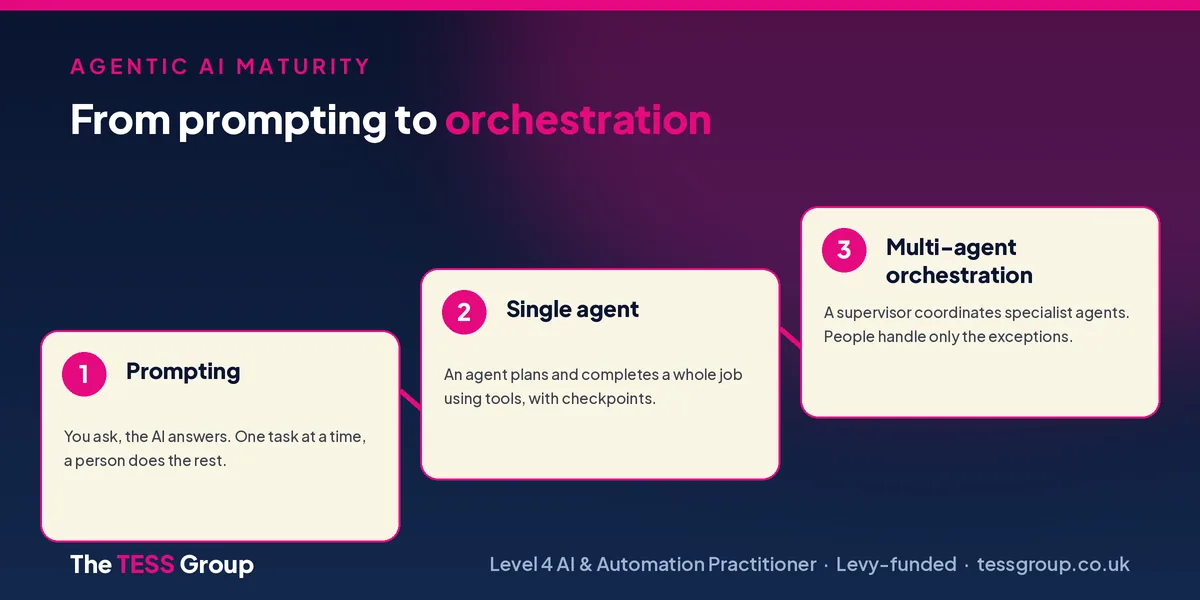
A chatbot answers a question. An AI agent completes a job: it takes a goal, plans the steps, uses tools and data to execute them, and only comes back to a human when something needs judgement. Agentic AI is the discipline of building, coordinating and supervising those agents so they work reliably inside a real business.
That is the shift that matters in 2026. Prompt skills still help, but the teams creating measurable ROI now are the ones who can take a process like invoice triage, customer enquiries or report production and hand it to a governed agent, then prove to a manager (or an auditor) that the agent is behaving. Prompting makes one person faster. Agentic AI changes how the work itself gets done.
Why UK employers are moving to multi-agent systems.
Prompting plateaus. Once everyone can write a decent prompt, the next gain does not come from better prompts, it comes from agents that own whole steps of a process, and from orchestrating several of them together. That is why multi-agent AI training is one of the fastest-rising asks from UK employers.
Prompting alone stops paying off
A faster individual is nice. A process that runs itself is transformational. The value is in handing repetitive, multi-step work to a governed agent, not in shaving minutes off a chat.
Capability that grows without hiring
One supervisor agent routing work to specialist agents lets a small team absorb more volume. You scale output without scaling the payroll at the same rate.
Agents you can actually let loose
Autonomy only works with guardrails: human-in-the-loop checkpoints, audit trails and monitoring. Employers want people who can build agents and prove they behave.
The people who can do this are scarce
AI agent orchestration training is new, so the talent is thin and expensive to hire. Building it in your existing team, on the levy, is the faster and cheaper route.
What your team will actually learn on the Level 4 agentic AI route.
Four capabilities run through the AI & Automation Practitioner Level 4 curriculum, in order. Every apprentice builds real agents on real work from their own role, so you can build AI agents on your actual processes, not toy examples.
Design and build AI agents
Scope which workflows genuinely suit an agent, then design and build it: instructions, knowledge, triggers, tool connections and permission boundaries. Built in Copilot Studio, Gemini Gems and AppSheet, with RAG (retrieval-augmented generation) for grounding agents in company knowledge.
Orchestrate agents that work together
Coordinate specialist agents into one workflow: supervisor and worker patterns, sequential hand-offs, and routing logic built in Power Automate, Make.com and Zapier. Learners ship multi-agent workflows that pass work between agents and people cleanly.
Let agents execute, with guardrails
Move from human-does-everything to agent-does-the-routine: trigger-based autonomous execution with human-in-the-loop checkpoints for the decisions that matter. Error handling, fallbacks and escalation rules are part of every build, not an afterthought.
Monitor, evaluate and maintain
An agent you cannot measure is an agent you cannot trust. Apprentices learn to maintain the agents they deploy: output evaluation, sampling and spot checks, trust thresholds, audit trails and the maintenance habits that keep automations reliable month after month.
What agentic AI looks like on the bottom line.
Three agents UK teams are building right now, and the ROI they target. Apprentices build versions of these on your own processes.
Invoice processing agent
Reads incoming invoices, extracts the data, checks it against the purchase order, queues clean ones for payment and flags only the exceptions for a human.
ROI: hours of manual keying removed, fewer errors.
Customer query agent
Handles repetitive first-line queries end to end, drafts replies grounded in your own knowledge base, and escalates the genuinely tricky ones to a person.
ROI: faster responses, people freed for complex cases.
Internal knowledge agent
Answers staff questions from your own policies and documents, so people stop interrupting colleagues for the same answers and get a consistent one.
ROI: less time lost searching, consistent answers.
The common thread is the ROI case for agentic AI: time saved, fewer errors, and capability that scales without adding headcount. Because apprentices build on your real processes, the value lands inside your business, not in a sandbox.
Ready to build real agentic capability in your team?
Explore the Level 4 apprenticeship →Agentic AI vs traditional AI training: why the Level 4 apprenticeship wins.
A prompt-engineering course teaches one person to ask better. An agentic AI apprenticeship builds people who make the work run itself, and gives you something to show for it.
Teaches better prompts for one person at a time
A one-off day, with no recognised qualification
You still do the work, just a little faster
Nothing governed, monitored or audit-ready
Builds people who design, orchestrate and monitor agents that do the work
12 months on your real processes, up to 5 qualifications including Microsoft and BCS
100% levy-funded (ST1512, £18,000 band), no coding required
Governed, monitored and audit-ready by design
This is why the AI & Automation Practitioner Level 4 is currently the best funded route in the UK to build proper agentic AI skills: agentic AI at Level 4, paid for by the levy you already contribute.
Want to see exactly how agentic AI could work in your organisation? Book a free 20-minute Agentic AI Opportunity Call and we will map 2 to 3 high-ROI agent use cases for your team.
Book an Opportunity Call →How to get started with agentic AI: apprenticeship or workshop.
Build deep capability with the funded apprenticeship, get working agents fast with a workshop, or do both. Here are the routes.
AI & Automation Practitioner (Level 4)
The full agentic AI apprenticeship: 12 months plus EPA, up to 5 qualifications including Microsoft and BCS, 100% levy-funded at £18,000. No coding. Available in Microsoft 365 and Google Workspace editions.
Explore the Level 4 → Fast startBuild AI Agents workshop
A 1 or 2 day closed cohort for teams that need working agents now. Single-agent builds on day one, multi-agent orchestration and governance on day two.
See the workshop → Advanced · EnterpriseMicrosoft Foundry for Enterprise
For engineering teams in bigger corporates: production agents on Microsoft Foundry with Foundry IQ grounding, Control Plane governance and agent observability.
See the advanced day →Agentic AI, answered.
What is an agentic AI apprenticeship?
An apprenticeship that teaches people to design, build, orchestrate and monitor AI agents: software that plans and executes multi-step work autonomously rather than answering one prompt at a time. At TESS this is delivered through the Level 4 AI & Automation Practitioner (ST1512), fully funded by the apprenticeship levy.
What is the difference between agentic AI and generative AI?
Generative AI, including prompting a chatbot, produces content when you ask. Agentic AI uses that intelligence to act: an agent plans and runs a multi-step task using tools and data, and only involves a human for judgement. The Level 4 apprenticeship teaches the agentic part, building, orchestrating and monitoring agents.
Does agentic AI need coding?
No. Agents are built and orchestrated in low-code and no-code platforms (Copilot Studio, Gemini Gems, Power Automate, Make.com, Zapier). The orchestration logic is visual, so people in HR, finance, marketing and operations can build production agents without writing code.
What is multi-agent orchestration?
Coordinating several specialist agents to complete one workflow, usually with a supervisor agent routing work to worker agents and escalating edge cases to a human. It is taught and assessed as part of the Level 4 curriculum, and goes deeper on our Build AI Agents and Microsoft Foundry days.
What is agent performance monitoring?
The practice of keeping autonomous agents reliable once deployed: evaluating outputs, sampling decisions, setting trust thresholds, and keeping audit trails your compliance team will accept. ST1512 requires apprentices to maintain the agents they build, not just ship them.
Is the agentic AI apprenticeship levy-funded?
Yes. Through the apprenticeship levy at the £18,000 funding band, so levy-payers pay nothing extra. Non-levy SMEs are typically 95% co-funded. Workshops are self-funded but can often be structured into cohort spend. Check your levy position.
Where do leaders fit into agentic AI?
Practitioners build the agents; leaders decide where agents are allowed to act. Our AI Leadership Units (AU0009 to AU0011) cover strategy, policy and delivery for the managers governing agentic AI, and the AI & ML Fellowship (L6) is the senior route.
Stop prompting. Start orchestrating.
Tell us which workflows you want agents to handle and we will recommend the best route: levy-funded apprenticeship, workshop, or both.