The headlines
- Government wants public bodies to use AI: the AI Playbook for Government and the AI Opportunities Action Plan set the direction.
- A government trial of 20,000 civil servants found AI saved around 26 minutes a day, nearly two weeks a year.
- Adoption still stalls for a real reason: data security, compliance and patchy skills, not a lack of interest.
- The fix is governance plus training: safe-use guardrails and people who know how to apply them, often starting with Microsoft Copilot.
- You are very likely already paying for it: the levy NHS trusts, councils and schools pay funds accredited AI training.
There is a familiar shape to AI in a public-sector organisation: two or three leaders pushing hard for it, and almost everyone else unsure whether they are even allowed to touch it. The enthusiasm is real, the caution is real, and the gap between them is where adoption quietly stalls. Turning a beast like an NHS trust or a county council towards a new way of working is not a one-meeting job.
None of that means the caution is wrong. Public bodies hold some of the most sensitive data there is, and the consequences of getting AI wrong are not a bad quarter, they are a front-page failure of public trust. The good news is that safe adoption is a solved problem in principle. It comes down to AI training and governance, both of which you can build deliberately. This guide covers safe AI use in the public sector, AI governance for councils and NHS trusts, and how to fund it. Here is how.
Sources: GDS / GOV.UK civil service AI trial (2025), Alan Turing Institute, World Economic Forum Future of Jobs Report 2025.
Why public-sector AI adoption stalls (even when everyone agrees on it)
Central government has made its position clear. The AI Playbook for Government, published in February 2025, sets out ten core principles for using AI safely and effectively across public services, and the AI Opportunities Action Plan pushes departments to adopt it. The NHS has its own commission to accelerate AI use. The direction of travel is not in doubt, and the evidence is now real: a landmark government trial of 20,000 civil servants found Microsoft 365 Copilot saved them around 26 minutes a day, close to two working weeks a year.
And yet, on the ground, it stalls. The National Audit Office has repeatedly pointed to the same blockers in public-sector technology: skills gaps, cultural barriers, legacy systems and fragmented responsibilities. In plain terms, the strategy says go, but the people, the systems and the confidence are not all in place. AI does not fail in the public sector because it is a bad idea. It fails because the organisation has not been brought along.
A handful of champions, a nervous middle, and a frontline that has heard "do not use it" more often than "here is how to use it safely". The champions cannot scale themselves. The fix is to give everyone else permission and competence, with guardrails.
The real blockers: data security, compliance and trust
Be honest about why people hesitate, because the fear is reasonable. A council or an NHS trust handles citizen and patient data where a single careless paste into a public tool is a genuine breach. Clinical and regulatory teams worry about liability. Information-governance leads worry about where data goes and who can see it. These are not excuses, they are the job.
So the answer is not "be braver". It is to make the safe path the easy path. That means clear rules on what data never goes into a tool, approved and appropriately secured tools for anything sensitive rather than consumer apps, a human in the loop on every decision, and alignment to the government's AI Playbook and the Data and AI Ethics Framework. Get those guardrails in place and most of the fear dissolves, because people finally know what "allowed" looks like.
Public-sector AI does not fail because it is a bad idea. It fails because the organisation was told to adopt it without being shown how to do it safely.Lisa O'Reilly, Director, TESS Group
Why open AI courses often miss the mark for public bodies
Most off-the-shelf AI training is built for a general audience. For a private SME that is fine. For local government or an NHS team it often lands badly: the examples do not fit, the compliance angle is missing, and people sit there thinking none of this refers to me, and I have rules nobody else in this room has. They are not wrong.
That is why, for public bodies, we favour closed, sector-specific cohorts. Same core skills, but the use cases, the data rules and the worked examples are drawn from public-sector work, whether that is a council service, an NHS function or a school. People engage when the training obviously speaks to their job and their obligations, and it is safer, because the guardrails are taught in the context they actually apply.
Why Microsoft Copilot is the safest starting point for most public-sector teams
If your organisation already runs on Microsoft 365, you very likely have the safest on-ramp to AI sitting right there: Microsoft Copilot. The reason it is a better starting point than a public consumer chatbot is where your data goes. When Copilot runs inside your organisation's Microsoft 365 tenant, your prompts and data stay within your environment and are not used to train the public foundation models. For a public body that has to account for every byte of citizen or patient data, that distinction matters.
It is not a magic shield: Copilot still needs the right configuration, access controls and guardrails, and a human reviewing what it produces. But it lets staff build genuine safe-use skills on data that stays in your control, which is exactly why the government's own 26-minutes-a-day trial used Microsoft 365 Copilot. The practical move is to give frontline staff Copilot literacy first, then build towards the apprenticeship. Our practical Copilot guide for business teams walks through the prompting frameworks and guardrails we teach, and Microsoft Copilot training for the public sector is where most of our public-sector cohorts begin.
Who needs what: not everyone is an AI Practitioner
One of the most expensive mistakes is assuming everyone needs deep, technical AI training. They do not. The efficient approach is to match the level of training to the role, which also keeps oversight proportionate to risk.
| Who | What they actually need | Risk & oversight | Funded TESS route |
|---|---|---|---|
| Frontline & admin staff | Safe-use literacy: prompt well, know what not to put in, check the output | Low, with guardrails | Short AI Apprenticeship Units |
| Managers & service leads | Judgement and oversight: govern AI, spot good vs bad use, set the rules | Medium, they set oversight | AI for Leaders & Managers L4 + AI Adoption & Governance unit |
| Digital, data & improvement teams | Build automations and workflows safely on real processes | Medium to high | AI & Automation Practitioner L4 |
| HR & people teams | Adopt AI responsibly in people processes | Medium | AI for People Leaders L4 |
Most of your organisation sits in the first two rows. A leader does not need to build a model; they need to know what good looks like, that what you put in matters, and that what you get out must be checked. That is a far cheaper, faster capability to build across a workforce, and it is what actually unlocks adoption. (We go deeper on this in our guide to the new roles AI is creating.)
Not sure who needs which level? We will map your teams to the right tier of AI training, and keep it compliant.
Map our teams →Funding it: the levy you already pay
Here is the part many public bodies miss. NHS trusts, councils and large schools and trusts pay the apprenticeship levy (now the Growth and Skills Levy), and that money can fund accredited AI apprenticeships. Large public employers often have substantial levy pots sitting underused, sometimes far larger than the SMEs we also work with realise is even possible.
In other words, the budget for safe AI capability may already exist. It is not a new line item to fight for; it is redeploying money you are already contributing into the skills your organisation needs anyway. AI training for the NHS and local government, the AI & Automation Practitioner Level 4 and the leadership routes, is all delivered on that funding.
How to adopt AI safely: the 5-step framework
You do not need a grand transformation programme to begin. A safe, credible first move follows five steps.
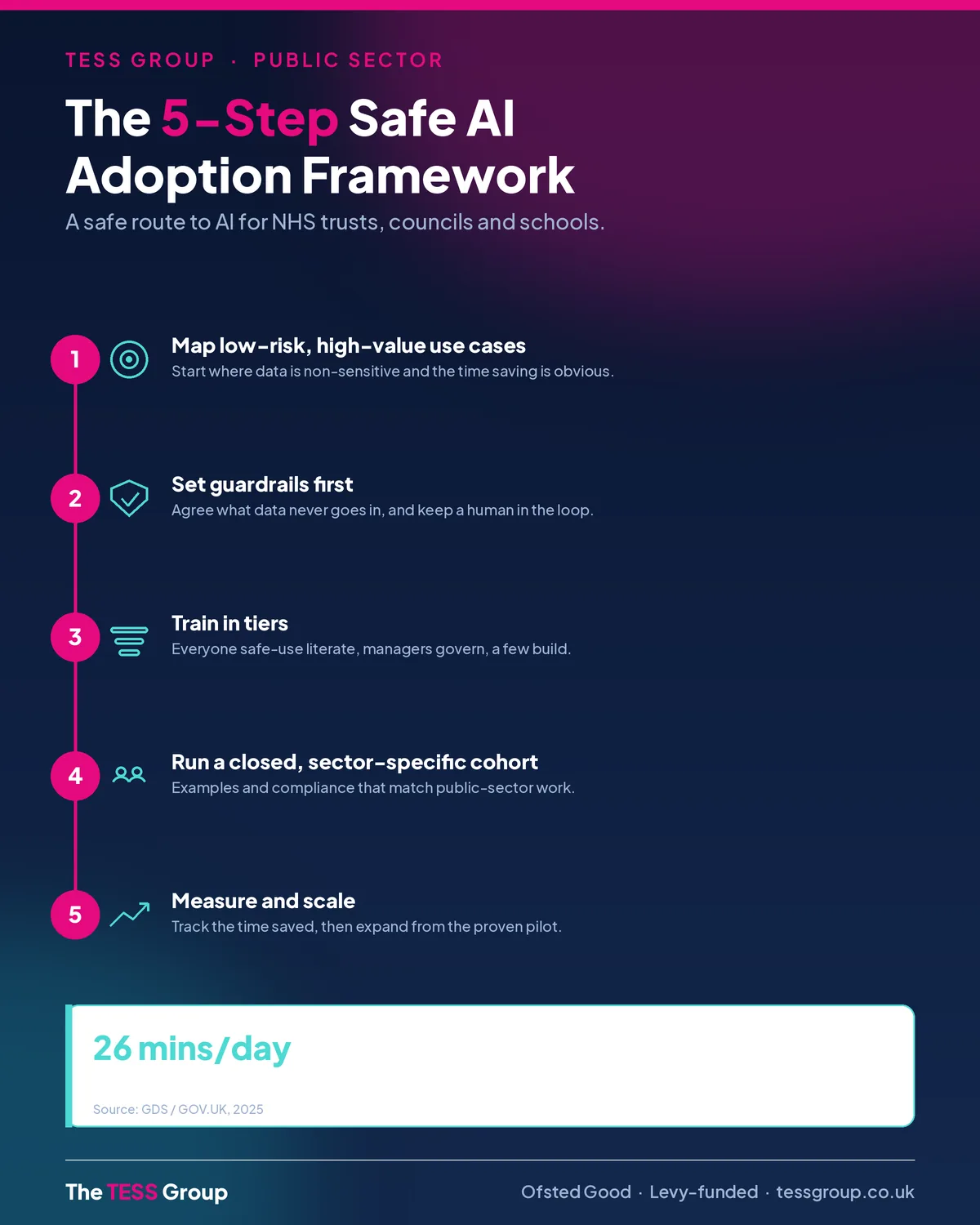
Map low-risk, high-value use cases. Start where the data is non-sensitive and the time saving is obvious: drafting, summarising, routine admin, not anything touching citizen or patient records.
Set guardrails first. Agree what data never goes into a tool, keep a human in the loop, and align to the AI Playbook principles and your information-governance rules before you scale.
Train in tiers. Give everyone safe-use literacy, train managers to govern, and develop a smaller group who can build automations.
Run a closed, sector-specific cohort. Use examples, compliance and data rules that match public-sector work, so it lands and stays safe.
Measure and scale. Track the time saved on the first use cases, then expand from the pilot once the guardrails are proven.
Book a free Public Sector AI Readiness Call. We will map which teams need what level of training, and how to stay compliant while you do it.
Book a readiness call →What this looks like in practice
The clearest way to see it is a single task, before and after.
A team hand-builds the weekly performance report: pulling figures, formatting tables, writing the summary. Half a day, every week, on work nobody enjoys.
AI drafts the summary from the same figures and formats it; a manager checks and signs off. Under an hour, the human still firmly in control.
A council nervous about data
Start a closed cohort of service managers on AI for Leaders & Managers. They learn to govern AI, set the data rules, and run safe pilots in non-sensitive areas first, building confidence before anything touches resident data.
An NHS team drowning in admin
Put a few improvement-team members through the AI & Automation Practitioner Level 4 to automate the safe, repetitive admin around the edges of clinical work, freeing time without going near a diagnosis.
A school or college rolling out Copilot
A licence is not capability. A short AI unit gives staff safe-use Copilot literacy fast, the same gap we cover in our practical Copilot guide.
How TESS supports public-sector teams
We are an AI apprenticeship specialist, and public-sector adoption is exactly the problem our programmes are built to solve: governance-aware, tiered by role, and deliverable as closed, sector-specific cohorts. Everything is funded through the levy you already pay, and no coding background is required to start.
Tell us your service area and your main concerns, and we will send you a short recommendation report mapped to your levy funding: which teams to train, at what level, and how to keep it compliant. No commitment.
Get our adoption plan →Frequently asked questions.
Is it safe for the NHS or a council to use AI?
Yes, when it is governed properly. The risk is not the technology itself but how it is used: sensitive citizen or patient data should never be pasted into public AI tools, a human should review every decision, and use should follow the government's AI Playbook principles and your own information-governance rules. Safe adoption is a training and governance question, which is exactly what public bodies can build.
Can public bodies use the apprenticeship levy for AI training?
Yes. NHS trusts, councils, schools and other public bodies pay the apprenticeship levy (now the Growth and Skills Levy) and can use it to fund accredited AI apprenticeships such as the AI and Automation Practitioner Level 4 and AI for Leaders and Managers. Large public employers often have substantial levy pots that are underused.
How do we handle data security and citizen data with AI?
Set clear guardrails before you scale: define what data can never be entered into a tool, use approved and appropriately secured tools rather than public consumer apps for anything sensitive, keep a human in the loop on decisions, and align to the government's AI Playbook and the Data and AI Ethics Framework. Training staff to understand these rules is the single biggest safeguard.
Is Microsoft Copilot safe for public-sector use?
For teams already on Microsoft 365 it is usually the safest starting point. When it runs inside your organisation's tenant, Microsoft 365 Copilot keeps your data within your environment and does not use it to train the public foundation models, unlike a public consumer chatbot. It still needs the right configuration, access controls and guardrails, and a human reviewing output, but it lets staff build safe-use skills on data that stays in your control.
Does everyone need to be trained as an AI practitioner?
No. Most staff only need safe-use literacy: how to prompt well, what not to put in, and how to check output. Managers need to govern and oversee AI, and a smaller group needs to build automations. Matching the level of training to the role is cheaper and more effective than trying to make everyone a specialist.
Can AI training be sector-specific or a closed cohort?
Yes, and for public bodies it usually should be. Open cohorts can feel irrelevant when local government or NHS staff have specific compliance and data requirements. A closed, sector-specific cohort uses examples, use cases and guardrails that match public-sector work, which lands far better and is safer.
Related: AI apprenticeships for NHS trusts