The headlines
- In 2024/25, 54.2% of levy-paying employer accounts spent 25% or less of the funds that entered their account that year.
- Nearly seven in ten (68.7%) spent half or less. Only about one in five spent 76% or more.
- From August 2026, unused levy funds will expire after 12 months, not 24, and the 10% government top-up is being removed.
- The displayed balances are notional: around £6.7bn in total, far more than the annual budget. The real constraint is the budget, rising to £3.3bn for England in 2026/27.
- The sensible response: plan and use the levy entering your account, on training your team actually needs.
A written parliamentary answer rarely makes for gripping reading, but this one is worth your attention. On 29 June 2026, the Department for Work and Pensions confirmed in writing what apprenticeship providers have seen for years: most employers who pay the levy use only a small fraction of it. In 2024/25, 54.2% of levy-paying employer accounts spent a quarter or less of the funds that went into them that year.
It is a striking number, and it lands just as the rules tighten. From August, the window to use your levy halves. So this is a good moment to look at the figures honestly, understand what is changing, and decide to turn money that would otherwise drain away into skills your business will keep.
What the new figures show
The data comes from a written answer by Andrew Western MP, responding to a question from Richard Holden MP, covering levy-paying employer accounts in England in 2024/25. It breaks down how much of the funds entering each account were actually spent that year.
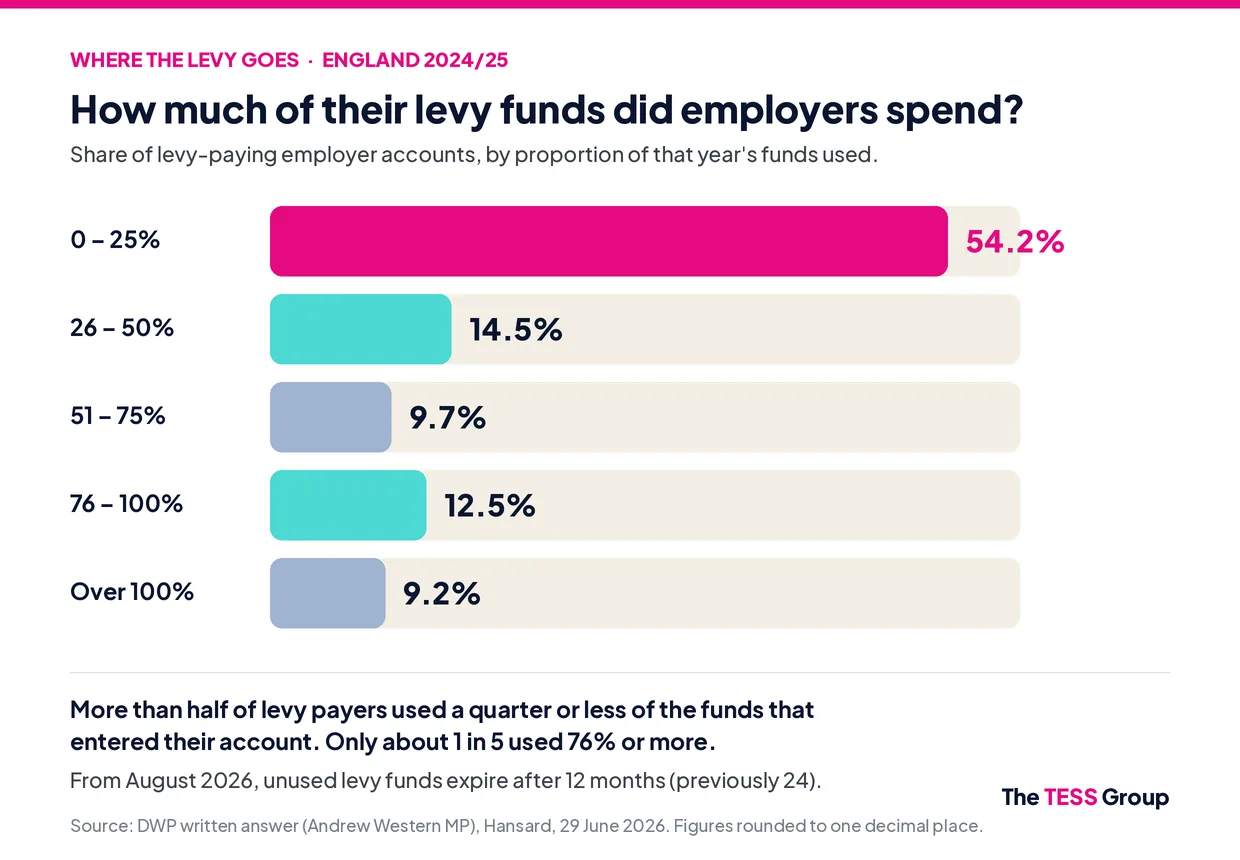
The pattern is hard to miss. The single biggest group, by a distance, spent almost nothing. Combine the bottom two bands and 68.7% of accounts used half or less of that year's funds. The "over 100%" group (9.2%) is not a contradiction: because funds accrue for up to 24 months, some employers spend more in a year than entered the account that year, drawing down an earlier balance.
For context, the levy is paid at 0.5% by employers with a pay bill over £3 million. It is not legally ring-fenced for apprenticeships, the money goes into the Consolidated Fund, while a separate annual budget funds training in England. That budget was 100% spent in 2024/25. So the system as a whole is not sitting idle. It is that, employer by employer, most levy payers leave most of their own allocation unused.
Why this matters more from August
Two changes take effect from August 2026, and both make underspending costlier:
- Funds expire after 12 months, not 24. You will have half as long to commit each month's funds before they are lost. A "we will get to it next year" approach stops working.
- The 10% top-up has ended. Funds entering your account from 1 August 2026 no longer get the extra 10%, so your account reflects what you pay in.
The government's framing is about sustainability: the budget is rising to £3.3 billion for England in 2026/27, but it has to fund SMEs too, so it wants account balances to reflect what is actually affordable. Whatever you make of the policy, the practical effect for an employer is the same. The runway to use your levy is shorter, so a plan matters more than it did. We set out the wider rule changes in our guide to the 2026/27 funding rules and the 2026 funding changes.
"My account shows a big balance, why can't I spend it all?"
This is the part that genuinely confuses employers, and the minister addressed it directly. The funds shown in levy accounts are notional. In total they come to around £6.7 billion, which is far more than the levy paid each year and more than double the annual budget. If every employer spent every displayed pound, the budget would be blown and there would be nothing left to train apprentices at non-levy-paying SMEs, who currently make up nearly 30% of apprenticeship spending.
So the big number in your account is not a pot you can fully draw down on demand. The honest way to read it: focus on the funds entering your account and use them while you can. That is squarely within your control, and from August the timer on it is shorter. If you want the mechanics, our Growth & Skills Levy page explains how accounts and spending work.
How to actually use your levy (before it expires)
Levy funds pay for approved apprenticeship training and assessment, for new and existing staff, at any level from 3 to 7. You do not need to hire to spend it, you can upskill the team you already have. The most future-proof thing to train them in right now is AI, and you do not need technical backgrounds to start:
- AI Champion (Level 3): an entry route to build confident, everyday AI users across a team.
- AI & Automation Practitioner (Level 4): our Level 4 apprenticeship, which turns someone with no coding background into a practical automator of real work.
- AI Leadership (Level 5): for managers who need to lead AI adoption, not just use the tools.
- Machine Learning Engineer (Level 6): a degree-level route for deeper technical capability.
If you would rather see the spending mechanics first, we have a step-by-step guide on how to use your apprenticeship levy for AI training.
What to do now
- Check what is entering your account. Look at monthly inflows, not just the headline balance, and note the new 12-month clock from August.
- Pick the team and the level. Decide who would benefit most and at what level, from a Level 3 cohort across a department to a Level 4 specialist.
- Commit funds before they expire. Starting a cohort draws down funds against training that is already delivering, rather than letting them lapse.
- Get a quick levy review. We will map your likely inflows to the right programmes and show what your levy can cover.
If you are in the 54%, your levy is training other people's teams instead of yours. Turn it into capability before the August clock shortens. The AI & Automation Practitioner Level 4 is fully levy-funded and needs no coding.
Book a free levy review →Figures are from the DWP written answer of 29 June 2026 (Hansard, HC Deb, 29 June 2026, cW). The spend percentages describe funds used during 2024/25 against funds that entered each account that year. Always confirm current rules before planning levy spend.
Frequently asked questions.
What proportion of employers underspend the apprenticeship levy?
According to a DWP written answer published on 29 June 2026, in 2024/25 some 54.2% of levy-paying employer accounts spent 25% or less of the funds that entered their account that year. A further 14.5% spent between 26% and 50%. Only about 21.7% spent 76% or more (12.5% spent 76 to 100%, and 9.2% spent over 100% by drawing on funds accrued in earlier months).
How is the apprenticeship levy changing from August 2026?
From August 2026 the government is removing the 10% top-up it adds to levy accounts and reducing the period before unused levy funds expire from 24 months to 12 months. The stated aim is to align levy balances more closely with the actual annual growth and skills budget, which is rising to £3.3 billion for England in 2026/27.
If my levy account shows a big balance, can I spend all of it?
Not necessarily. The government has said the funds shown in employer accounts are notional and, at around £6.7 billion in total, far exceed the levy paid each year and more than double the annual budget. The real constraint is the annual growth and skills budget. The practical takeaway for an individual employer is to plan and use the funds entering your account before they expire, rather than assume a large displayed balance is all available.
What happens to apprenticeship levy I do not spend?
Unused funds in your account expire. From August 2026 that happens after 12 months rather than 24, so the window to commit your levy to training is shorter. Funds you do not use effectively support the wider system, including apprenticeships at non-levy-paying SMEs, which currently account for nearly 30% of apprenticeship spending.
How can employers actually use their apprenticeship levy?
You can spend levy funds on approved apprenticeship training and assessment for new or existing staff, at any level from 3 to 7. TESS Group offers levy-funded AI apprenticeships from the AI Champion at Level 3, through the AI & Automation Practitioner at Level 4, to leadership units at Level 5 and a Machine Learning Engineer route at Level 6, none of which require a coding background to start.
Who published these levy figures?
The figures come from a written parliamentary answer from the Department for Work and Pensions, given by Andrew Western MP on 29 June 2026, in response to a written question from Richard Holden MP. The data covers levy-paying employer accounts in England in the 2024/25 financial year.