The opportunity, in one line
- The government is steering apprenticeship money towards young people and priority skills like AI, not away.
- A funding-band review could lift rates for the standards most used by young people and priority sectors.
- The apprenticeship units model is being improved, and the first AI units drew "incredibly positive" feedback.
- Live incentives: free under-25 training from August and a £2,000 hiring grant from October.
- Move quickly and it means cheaper training and a stronger talent pipeline. The catch: no new money yet, so nothing is guaranteed.
The government is reshaping apprenticeship funding in 2026, with more money and incentives flowing towards young people and priority skills like AI. For employers who move quickly, that means cheaper training and a stronger talent pipeline. In 48 hours at the AELP conference the skills minister set off three changes at once, a funding-band review, a rethink of how apprenticeship units are paid for, and a clear pivot to young people. Reported separately they look like three stories; they are really one, and the direction is what matters.
Here is what each change is, the honest read on what it means, and, for an AI-focused employer, why the overall drift is more opportunity than threat.
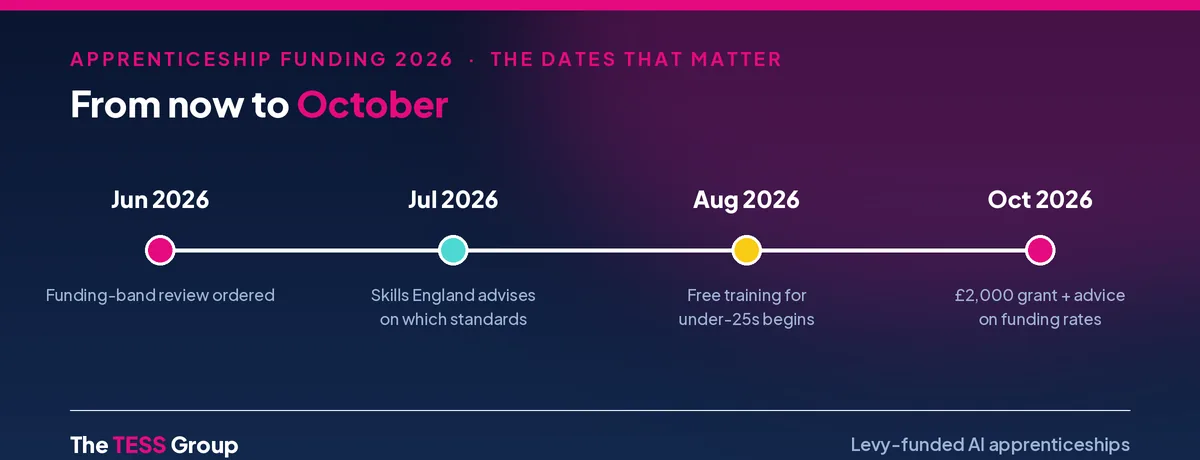
1. The funding band review
Funding bands set the maximum that can be drawn from the apprenticeship budget for a given standard, currently anywhere from £1,500 to £27,000. On 22 June the minister wrote to Skills England making a review an "immediate priority", asking it to identify which standards are not funded at a sufficient level and should be first in line for potential uplifts. Providers have argued for years that frozen bands have not kept pace with delivery costs, and the letter notes that six of the 20 most-used standards among under-25s have never had an uplift.
Two priorities are named: standards that drive starts for under-25s, and standards that support growth and the priority skills to 2030 in the government's industrial strategy. Skills England advises on which standards by July, and on the rates by October. The honest caveat: no new money has been allocated, so any uplifts have to be found within a budget (£3.3bn) that has been fully spent in recent years.
2. The apprenticeship units payment fix
Apprenticeship units are the short, levy-funded courses launched in April, the first time levy money can pay for non-apprenticeship training, and our own AI Apprenticeship Units sit in this category. They have been paid on a 30/70 split: 30% to the provider at the start, 70% on completion. The DWP has now said that works for short units but not larger ones, and that it is already exploring alternatives after provider feedback, with recommendations going to ministers before the summer ends.
For employers the takeaway is simple: the units route is being actively improved, not pulled. And the most relevant line for us, the DWP reported that the first units in AI (and mechanical fitting) had "incredibly positive" early feedback, with more units to come. The bumps are in the provider payment mechanics, not in the value to the employer.
3. The pivot to young people (and "not the end of the road")
Underneath both moves is one strategy: shift apprenticeships back towards young people. Under-25 starts have fallen around 40% over the past decade, and the government wants 50,000 more young starts by 2029. That is why the 2026/27 rules bring free training for under-25s at non-levy employers from August and a £2,000 hiring grant from October, and why the band review leans towards youth-heavy standards.
The minister was candid that more reform may follow. She said there are no plans for further defunding or age caps "at the moment", but called it "not the end of the road". That is worth watching, but note where the risk has fallen so far: Level 7 for over-22s, and 16 mostly older-worker management standards. The exposed side of this pivot is legacy, older-worker provision. The favoured side is young people and priority skills.
The three changes at a glance
Funding band review
Skills England to flag standards for uplifts, prioritising young people and priority skills.
For you: priority standards, likely including AI, could be funded higher.
Units payment fix
The 30/70 split is being reworked for larger units after provider feedback.
For you: the short-course units route is improving; AI units already well-reviewed.
Pivot to young people
Free under-25 training (August) and a £2,000 hiring grant (October).
For you: hiring and training under-25s gets cheaper now.
Why the 2026 changes favour AI apprenticeships
If your provision is older-worker management training, this pivot is a headwind. If it is AI and priority skills, including for young people, the money is being steered towards you, with cheaper training and a possible funding uplift on the table.
It would be easy to spin this as unreservedly great news, and we will not pretend it is: there is no new money, no specific standard has been promised an uplift, and "not the end of the road" means the rules can still move. But on the substance, three things genuinely favour AI-focused provision.
- AI is a named priority skill. The review explicitly prioritises "growth and priority skills to 2030" in the industrial strategy. AI and digital are central to that, so AI standards are exactly the kind of provision the review is designed to protect and potentially uplift.
- The youth pivot points the same way. AI apprenticeships are an attractive, future-facing route for young people, and the under-25 incentives (free training, the £2,000 grant) make them cheaper to start now.
- The AI units are landing well. The DWP singled out AI units for "incredibly positive" early feedback, and the payment model is being improved rather than scrapped.
That is the side of the line the AI & Automation Practitioner Level 4 and our wider AI routes sit on.
Want to understand exactly how these changes affect your apprenticeship plans? We'll map it for you.
Map my plans →What it means, by employer type
The same changes land differently depending on what you train and who you hire.
Smaller employer hiring under-25s
Free training from August plus a £2,000 grant from October. A young apprentice is cheaper to take on than at almost any point in recent memory.
AI / priority-skills employer
Your standards are the ones the band review is built to protect and potentially uplift, and the AI units are landing well. Lean in.
Older-worker / management-heavy
The pivot is away from legacy management provision (16 standards already defunded). Now is the time to look at AI and younger-talent routes.
What employers should do now
Nothing here is a reason to pause a live or planned programme. The practical moves:
- Mind the calendar. Advice on which standards lands in July, advice on rates in October, and the autumn Budget will decide whether any of it is funded. Plan around those points, not the headlines.
- Use the youth incentives. If you are hiring under-25s, the August free-training change and the October £2,000 grant make this an unusually good window. Time starts to capture them.
- Lean into AI and priority skills. That is where the funding intent, the youth pivot and the band review all point. It is also where the durable workforce demand is, the same theme as the London AI skills gap.
- Get a funding review. We will confirm what you would pay today, map your plans against the changes, and flag anything genuinely worth waiting for.
And the bigger reassurance, unchanged from when Keir Starmer announced he would stand down: apprenticeships remain a cross-party priority. The minister was explicit that young people and apprenticeships are "not an area that this government, under whichever leadership, is going to be de-prioritising", a point we made in new PM, same levy.
The rules are changing in your favour for AI and young talent. Let's make sure you're positioned to benefit. Tell us your team and timeline and we'll map these changes against your plans and the right AI route, with the new under-25 incentives applied for you.
Book a quick funding review call →Frequently asked questions.
What are the 2026 apprenticeship funding changes?
Three things announced at once in June 2026: a review of apprenticeship funding bands to identify standards for potential uplifts (prioritising young people and priority skills to 2030); a rethink of the 30/70 payment model for apprenticeship units; and a continued pivot of funding and incentives towards young people, including free under-25 training from August and a £2,000 hiring grant from October.
What is the 2026 apprenticeship funding band review?
On 22 June 2026 the skills minister asked Skills England to review apprenticeship funding bands and identify which standards should be first in line for potential funding uplifts, as an immediate priority. The focus is standards used by under-25s and those supporting growth and priority skills to 2030. Skills England is to advise on which standards by July and on funding rates by October. Funding bands currently range from £1,500 to £27,000.
Will AI apprenticeships get more funding?
Nothing is confirmed, but the signs are encouraging. The review explicitly prioritises growth and priority skills to 2030 aligned with the industrial strategy, and AI and digital sit squarely in that group, alongside standards used by young people. The first AI apprenticeship units also drew incredibly positive early feedback. No new money has been allocated yet, so any uplifts are not guaranteed, but AI-focused provision is well placed.
What is changing with the apprenticeship units 30/70 payment split?
Apprenticeship units currently pay providers 30% at the start and 70% on completion. The DWP has said this works for shorter units but not for larger ones, and is already exploring alternatives after provider feedback, with recommendations going to ministers before the summer ends. The first AI and mechanical fitting units were reported to have had very positive early feedback.
Does the pivot to young people change my apprenticeship levy?
The levy itself is unchanged. The pivot shows up in incentives and rules: fully funded training for under-25s at non-levy employers from August 2026, a £2,000 hiring grant from October, and a funding-band review aimed at standards used by young people. For most employers it makes hiring and training under-25s cheaper, not harder.
What should employers do now?
Nothing about live programmes needs to pause. If anything, the direction favours AI and priority skills and under-25 hires, which is where the incentives and likely uplifts point. Map your plans against the calendar (advice on standards in July, on rates in October, the autumn Budget) and get a funding review so you can act on the August and October incentives. TESS Group can map this with you.