The headlines
- On 16 July, China's Moonshot AI released Kimi K3, a 2.8-trillion-parameter open model with a one-million-token context window.
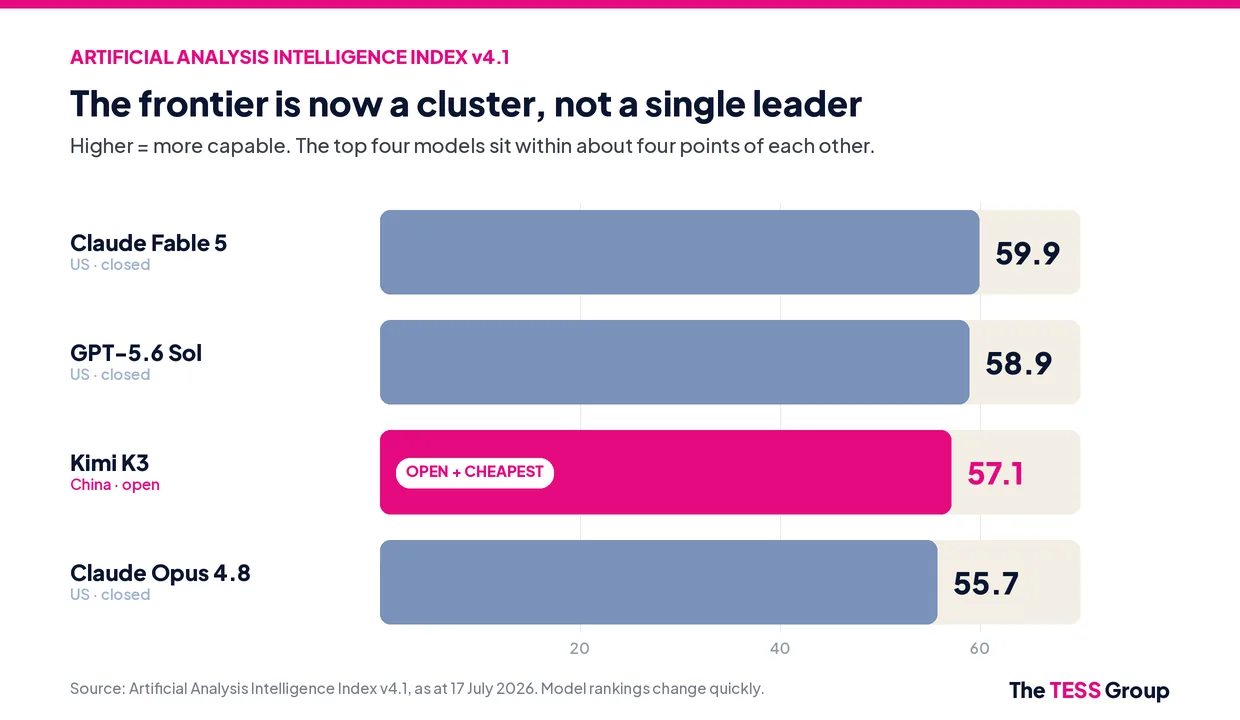
- It hit number one on Arena's Frontend Code leaderboard, the first time a Chinese model has topped it, and sits inside the top four on a broad intelligence index.
- It costs about a third of the price of the leading US models, and the full weights are due to be released openly by 27 July, so businesses can run it themselves.
- The frontier is now a cluster, not a single leader. The top four models sit within about four points of each other.
- The opportunity for employers: capable AI is getting cheaper, more open and more private. The winners will be the ones whose people can use whatever is best, not whoever bets on the right model.
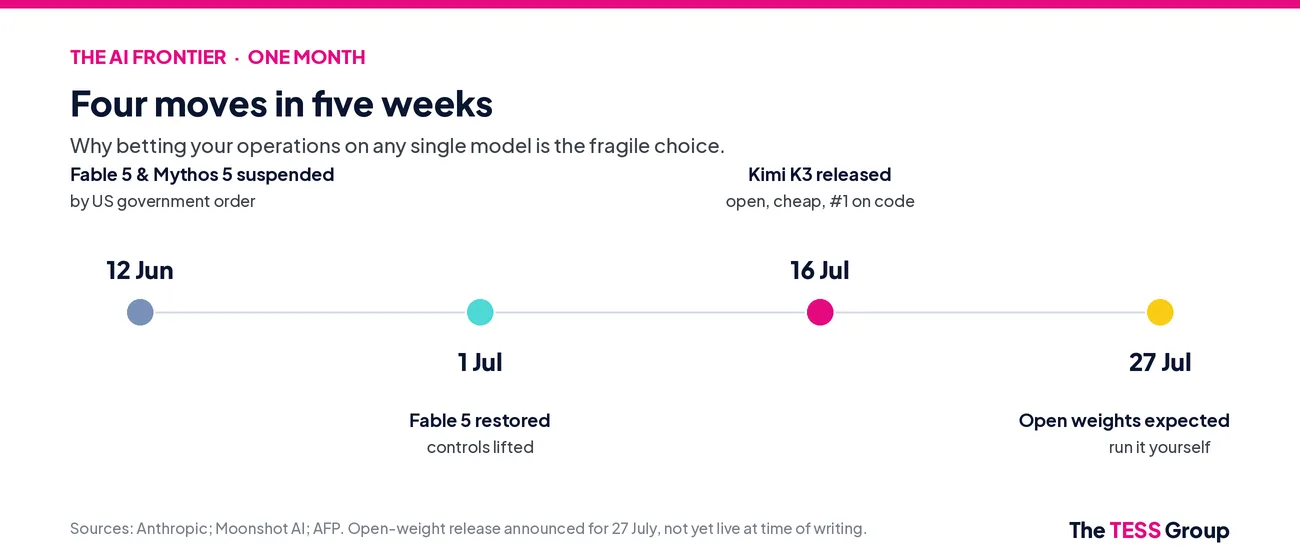
In June, we wrote about the most capable AI on earth being switched off overnight by a US government order. This week hands us the mirror image: a Chinese startup, Moonshot AI, has released an open model that matches the best on key benchmarks, at a fraction of the price, and will let you download and run it yourself within days.
Two opposite events in five weeks. One conclusion for any business: the model you build on is the least stable thing in your AI strategy. The good news is that this is an opportunity, not a threat, if you are set up for it.
What Kimi K3 actually delivered
Stripped of hype, here is what landed, and why each part matters to a business rather than a benchmark-watcher.
Scale you can use. Kimi K3 has 2.8 trillion parameters and a one-million-token context window. In plain terms, that context window means the model can hold roughly an entire codebase, all of your internal documentation, and months of meeting notes in its head at once, and reason across the whole lot in a single request. Tasks that used to need careful chopping-up can be done in one pass.
Frontier-level capability. It took first place on Arena's Frontend Code evaluation, ahead of Claude Fable 5, and sits fourth on the broader Artificial Analysis Intelligence Index. Crucially, the top four are now separated by only a few points.
A big drop in price. This is arguably the real story. Kimi K3 undercuts the US flagships by a wide margin on published API prices:
| Model | Input / million tokens | Output / million tokens | Availability |
|---|---|---|---|
| Kimi K3 (Moonshot) | $3 | $15 | Open weights (from 27 Jul) |
| GPT-5.6 Sol (OpenAI) | $5 | $30 | Closed |
| Claude Fable 5 (Anthropic) | $10 | $50 | Closed |
Published API list prices per million tokens, as at July 2026; prices change often. On a like-for-like workload, Fable 5 costs roughly 3.3x Kimi K3.
Openness you can host. Moonshot plans to publish the full weights by 27 July 2026, so an organisation can run the model on its own hardware. We will come back to why that matters for data.
The honest summary: Kimi K3 is at the frontier and leads on some measures, not the single best model in the world. But "an open Chinese model you can self-host now tops a major coding benchmark, at a third of the price" is a genuinely significant sentence.
Why this moment matters
Several commentators compared it to early 2025, when DeepSeek released a strong, cheap model and briefly wiped hundreds of billions of dollars off the value of US tech firms. The worry is familiar: if capable AI becomes cheap and open, it is harder to charge premium prices for a closed one.
But flip that round and it is an opportunity for everyone who buys AI rather than sells it. As the investor Gavin Baker put it, the release is "potentially negative for Anthropic and OpenAI while being net positive for essentially every other company in the world." Anastasios Angelopoulos, who runs the Arena leaderboard, made the practical point: businesses may come to prefer capable models they can run on their own computers over paid ones that require sending data to an outside company.
We are not going to litigate the US-China politics swirling around this, and there is plenty of it. Our interest is narrower and more useful: what a UK employer should take from it.
What UK employers should actually do
Three things, and the first is the mindset shift that makes the rest easy.
1. Stop trying to pick the winner. In five weeks the "best" model was launched, switched off, restored, and matched by an open rival. Anchoring your operations to any one model, US or Chinese, closed or open, is now the fragile choice. Build your AI processes so the model is a swappable component, and switching becomes a config change, not a rebuild.
2. Treat cheaper, more capable AI as a tailwind. The direction of travel is more capability for less money. If the tools get better and cheaper whoever wins, the advantage is no longer in owning the best model. It is in how well your people apply whatever is available. The bottleneck moves decisively from the tool to the skill, which is the one part you control.
3. Use openness for data control, with eyes open. Because Kimi K3's weights are open, a UK business could run it on its own servers, or on UK or EU cloud infrastructure, so sensitive data never leaves its control or its jurisdiction, instead of posting it to a US or Chinese provider's API. That is a real advantage for regulated or privacy-sensitive work. Set against it, some organisations will be cautious about a Chinese-built model on governance and procurement grounds. Neither point decides it for you: assess any model, this one included, on data handling, hosting and fit, not on the headlines.
The one thing that never changes
Every release this year has pointed at the same place. The models are extraordinary and getting cheaper, and not one of them is reliably yours to keep. The only part of your AI strategy you fully own is the capability in your own people.
We made a deliberate choice to teach on the newest platforms, not last year's. The day a model like Kimi K3 lands, it is in front of our apprentices as a live example, not a footnote a year later. That is how you build people who stay ahead of the curve instead of chasing it. Rod Doyle, Director, TESS Group
Picture a finance team that automated its month-end reporting commentary on one model this spring. When a cheaper, better model lands, the person who built it re-points the workflow in an afternoon and it keeps running. The value was never the model. It was the person who could build it and move it. That person treats a launch like this week's as an opportunity, not a fire drill.
Building that person is exactly what our AI apprenticeships do, and, by design, they are vendor-neutral. Apprentices work across Claude, Microsoft Copilot, Gemini and open models, and no-code automation tools, learning to design and govern workflows on whatever stack you run. The AI & Automation Practitioner Level 4 needs no coding background; our Claude Apprenticeship teaches through Claude precisely because the skill it builds transfers to whatever comes next.
A model like Kimi K3 is exactly the kind of thing our AI & Automation Practitioner Level 4 apprentices learn to handle. When a new model lands, we work through it together, using the same practical questions any business should ask:
- Is it actually better for us? Reading benchmarks critically instead of taking the headlines at face value.
- What would it cost? Comparing token pricing against the current stack for real workloads.
- Can we run it safely? Weighing open-weight self-hosting, data residency and governance.
- Should we switch, and how? Swapping a model into a live workflow without breaking it.
That is the difference between watching AI news nervously and using it deliberately.
For leaders and managers, the same release raises a different set of questions: when and whether to adopt a model like this, how to procure and govern a foreign-built or open model, and where it fits the roadmap. Those are the heart of our short AI Leadership units, and a launch like Kimi K3 is a natural case study in two of them: AI Strategy and Opportunity and AI Adoption, Procurement and Governance.
Employers don't want teams trained on tools that are already dated. Across our AI apprenticeships and leadership units we work with what is genuinely current, so the skills people finish with are the ones the market is actually asking for. Lisa O'Reilly, Director, TESS Group
What smart UK employers are doing this month
- Watching, not lurching. A new leader on one benchmark is not a reason to migrate everything. They are noting it and carrying on.
- Making their AI portable. Building processes so the model is a component they can change, not a foundation they are locked into.
- Applying normal governance. Assessing any model, Kimi K3 included, on data, security and hosting before it touches real work.
- Investing in operators, not licences. One trained person who can rebuild on any model is worth more than a stack of subscriptions to the model of the month.
The models will keep changing. The organisations that win are the ones building people who can adapt to whatever comes next. If you want to assess how vendor-neutral your current AI capability really is, book a short, no-obligation conversation with our team. The AI & Automation Practitioner Level 4 is fully levy-funded and needs no coding.
Book a short AI capability chat →Benchmarks and prices cited are a mix of Moonshot's own figures and third-party sources (Artificial Analysis, Arena, and published API price lists) and reflect the position at the time of writing. Model rankings and pricing change quickly. The open-weight release was announced for 27 July 2026 and had not yet taken place when this was written.
Frequently asked questions.
What is Kimi K3?
Kimi K3 is a large language model released on 16 July 2026 by the Chinese startup Moonshot AI. It has 2.8 trillion parameters in a mixture-of-experts design, a one-million-token context window and native multimodal understanding. Moonshot describes it as the world's first open 3-trillion-class model, and plans to release the full weights openly by 27 July 2026.
Is Kimi K3 better than Claude or GPT?
It depends on the test. Kimi K3 took first place on Arena's Frontend Code leaderboard, ahead of Claude Fable 5, the first time a Chinese model has topped that list. On the broader Artificial Analysis Intelligence Index it scored 57.1, placing fourth behind Claude Fable 5 (59.9) and GPT-5.6 Sol (58.9) but ahead of Claude Opus 4.8 (55.7). So it is at the frontier and leads on some measures, rather than being the single best model overall.
Is Kimi K3 free and open source?
Moonshot has said it will publish Kimi K3 as an open-weight model by 27 July 2026, meaning organisations can download and run it on their own infrastructure. It is also available now through Moonshot's own chat and coding tools and via a paid API, priced at around $3 per million input tokens and $15 per million output tokens, well below the leading US closed models.
Can UK businesses use Kimi K3 safely?
Technically yes, and the open-weight release means a business could run it on its own systems without sending data to an external vendor, which is a genuine data-control advantage. That said, some regulated organisations will be cautious about a Chinese-built model on governance and procurement grounds, and one former US official has predicted regulators may discourage its use. The sensible approach is the same as for any AI tool: assess it on data handling, governance and fit, not on hype.
Does Kimi K3 change our AI strategy?
Not the fundamentals. It reinforces a pattern that has repeated all year: the leading model changes every few weeks, and capability is getting cheaper. The durable investment is not a subscription to whichever model leads today, but people who can pick the right tool, wire it into a business process and govern the result, on whatever model is available. That capability transfers when the frontier moves again.
What should employers actually do about Kimi K3?
Do not rebuild everything around a new model. Note that frontier capability is commoditising, which is good news for buyers, keep your AI processes portable across models, apply the same data and governance checks you would to any tool, and invest in the skills that let your team use whatever is best at the time. Vendor-neutral AI training is the hedge that survives each new release.
Sources
Moonshot AI, Introducing Kimi K3 (16 July 2026). Reporting: AFP via Yahoo Finance (article since removed), plus coverage from Tom's Hardware, VentureBeat, Axios and Fortune. Benchmark figures: Artificial Analysis and the Arena leaderboard. Rankings change quickly; figures are as at the time of writing.