The headlines
- DWP plans show apprenticeship spending peaking at £3.298bn in 2026/27, then falling to £3.195bn and £3.161bn.
- DWP says this is the anticipated effect of restrictions on level 7 and management apprenticeships, part of a deliberate shift towards young people and critical skills.
- Levy receipts are forecast to rise to £4.7bn then £4.8bn. The estimated amount not returned to the system grows from about £700m to £1.14bn.
- Around £356m of the £725m announced for the growth and skills levy is still unallocated.
- The practical read: 2026/27 is the high-water mark. If you intend to train, the next 12 months are the most favourable conditions on current plans.
If you pay the apprenticeship levy, one line in the DWP's annual accounts should shape your training plans for the next 12 months. On the department's own figures, apprenticeship spending peaks this year and then goes down.
Not by a lot, and not by accident. But it arrives at exactly the moment your levy becomes harder to use: from August, unused funds expire after 12 months instead of 24, and employer co-investment jumps from 5% to 25%.
So the practical takeaway is unglamorous but genuinely valuable: on current plans, 2026/27 is the most favourable year in the system. If you are going to train people, doing it in the next 12 months costs less and risks less than waiting. Here is the evidence, in the government's own numbers.
The numbers: spending peaks at £3.298bn, then falls
The apprenticeships line in the DWP's accounts has climbed every year for five years. Then it turns.
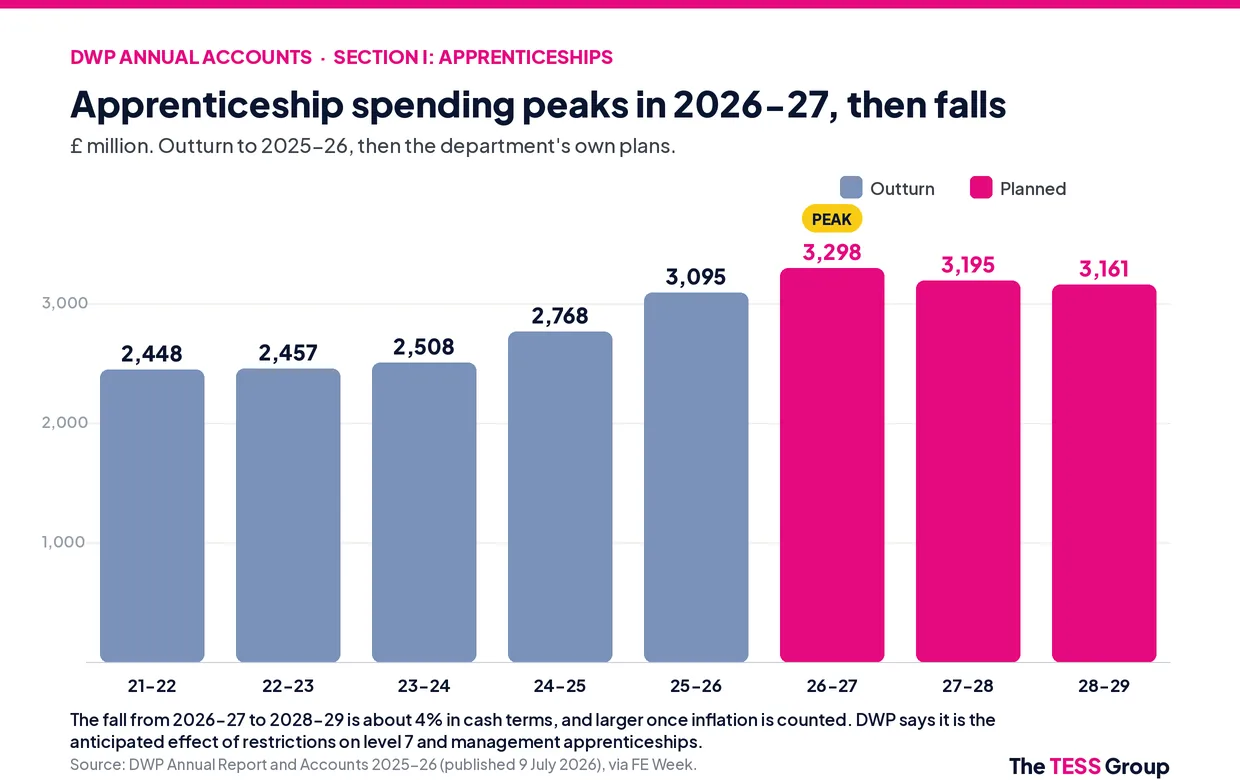
The context matters. The government overspent its apprenticeship budget for the first time in 2024/25.
In 2025/26, the original £3.075bn budget needed a £43m mid-year top-up to £3.118bn to meet demand. Final spend landed at £3.095bn.
For the current year the budget rose to £3.3bn, and DWP expects to spend 99.9% of it. This is a programme running hot: fully spent, with demand outstripping the envelope. And then, on plan, it falls.
Key takeaway: demand is currently outstripping the budget, yet the budget is planned to shrink from 2027/28. Competition for the same funding is unlikely to get easier.
Why it is falling: the government's stated intent
To be fair to the department, this is not presented as a cut to skills, and it is not unexplained. DWP says the fall is the anticipated effect of restrictions on level 7 and management apprenticeships.
Level 7 was defunded for those aged 22 and over from January 2026, except those aged 22 to 24 with an education, health and care plan or care experience. A further 16 standards lose funding this year, including popular management routes such as Team Leader Level 3, Operations Manager Level 5 and Chartered Manager Degree Level 6, which were mostly taken by existing, older workers.
There is a coherent policy behind this. Ministers have been under pressure to rein in spending since the pandemic pushed money towards expensive higher-level apprenticeships taken by older learners. The stated aim is to redirect that money towards young people and critical skills, with an ambition of 50,000 additional apprenticeship starts for young people by March 2029, reversing part of a decade in which starts among 16 to 24-year-olds fell by around 40%.
That is a defensible objective, and arguably an overdue one. The reasonable question for employers is simply whether the savings are reinvested or simply not spent.
The widening gap between levy paid and levy spent
This is where the accounts get interesting, and it is worth stating factually rather than dramatically.
The levy is not hypothecated. What employers pay does not set the apprenticeship budget; the Treasury sets that separately. The difference between the two is commonly called the top-slice. It has always existed. What the accounts show is that, on these plans, it grows.
Levy receipts vs England apprenticeship budget (£bn)
| Financial year | 2026/27 | 2027/28 | 2028/29 |
|---|---|---|---|
| Levy receipts (OBR forecast) | £4.5bn | £4.7bn | £4.8bn |
| England apprenticeship budget (DWP) | £3.298bn | £3.195bn | £3.161bn |
| Estimated Treasury top-slice | ~£700m | ~£1bn | ~£1.14bn |
Top-slice estimates are after around £500m a year goes to the devolved nations, per FE Week's analysis of the DWP accounts and OBR forecasts.
Read the top and bottom rows together. Employers are forecast to pay roughly £300m more levy by 2028/29 than this year, while planned spending on apprenticeships in England is £137m lower. The amount not returned to the system grows from about £700m to over £1.1bn a year.
Key takeaway: the levy you pay is rising while the budget it funds is planned to fall. That makes actually drawing down your own funds more valuable, not less.
The sector's view, from Simon Ashworth, deputy chief executive of the Association of Employment and Learning Providers:
With the levy itself generating record receipts, it would be a kick in the teeth for employers if this comes to fruition. It would also fly in the face of government priorities to deliver economic growth and tackle the NEET challenge. Simon Ashworth, Deputy CEO, AELP, quoted in FE Week
The £356m still unaccounted for
There is one loose end. In the November budget, £725m was committed for the growth and skills levy over this parliament.
Working from the 2025/26 outturn as a baseline, FE Week calculates the accounts show £203m added in 2026/27, £100m in 2027/28 and £66m in 2028/29. That totals £369m, leaving roughly £356m of the £725m not visible in the figures. DWP declined to say how the remainder will be divided.
It may yet appear. A Spending Review is expected, and plans are exactly that: plans, not announcements, and they can change.
Four changes converging on your levy in the next 12 months
Strip out the politics and a simple, practical picture emerges. On current plans, this year is the high-water mark, and several things tighten around it at once:
- From August 2026: unused levy funds expire after 12 months instead of 24, and the 10% top-up ends. We covered the scale of the problem in most employers underspend their levy, where 54.2% of levy payers used a quarter or less of their funds.
- From August 2026: employer co-investment for apprentices aged 25 and over rises from 5% to 25% when your levy funds run out; apprentices aged 16 to 24 stay fully funded. On a £9,000 band, that is the difference between £450 and £2,250.
- From September 2026: 16 standards lose funding, including management routes many employers default to.
- From 2027/28: the overall budget begins to decline.
Put together: the pot is at its biggest right now, the window to spend it is about to halve, the cost of exceeding it multiplies by five, and several popular routes disappear. There is no reading of that in which waiting is the stronger move.
The opportunity: where the funding is being redirected
It is worth being clear that this is not a retreat from apprenticeships. It is a shift away from expensive higher-level and management routes for older workers, and towards young people and critical skills.
If your plans sit on the right side of that line, this is arguably a good moment. The skills minister has commissioned Skills England to advise on which standards used by under-25s are underfunded, and there are now £2,000 hiring payments plus fully funded training for under-25s at non-levy employers.
AI, digital and automation sit squarely in the priority category. That is not a sales line so much as the logic of the reform: the AI & Automation Practitioner Level 4 requires no coding background and builds exactly the capability the industrial strategy is trying to grow, while the AI Champion at Level 3 suits a young or entry-level cohort. If you are losing a defunded management route, this is the natural home for that budget.
What employers should do now
- Look at your inflows, not your balance. With 12-month expiry from August, what matters is what enters your account each month and whether you commit it in time.
- Start before the tightening, not after. Cohorts starting in the next 12 months use the system at its most generous, on both expiry and co-investment.
- Re-plan any defunded routes now. If you run Team Leader L3 or a similar standard, decide the replacement before September rather than during it.
- Check your eligibility for the incentives. The £2,000 hiring payment and fully funded under-25 training apply to non-levy employers, and the rules are specific.
- Review your levy position this year. A short conversation is usually enough to see what is entering your account, what you would lose to expiry, and what is worth committing now.
If the plans hold, this is the most generous year for apprenticeship funding this parliament. A 30-minute call is enough to map your inflows, your expiry risk and the right programmes, with no obligation. The AI & Automation Practitioner Level 4 is fully levy-funded and needs no coding.
Book a short levy review →A note on certainty: the 2027/28 and 2028/29 figures are departmental plans, not announced cuts, and a Spending Review is expected. The fall is about 4% in cash terms and larger in real terms. We have reported the numbers as published and flagged where the analysis is FE Week's or AELP's rather than the government's.
Frequently asked questions.
Is the apprenticeship budget being cut?
Not in the sense of an announced cut. The DWP's annual accounts, published on 9 July 2026, show planned apprenticeship spending of £3.298bn in 2026-27, falling to £3.195bn in 2027-28 and £3.161bn in 2028-29. These are the department's own plans rather than a policy announcement, and a Spending Review is expected, so the figures could change. The fall is about 4% in cash terms and larger in real terms.
Why is apprenticeship spending expected to fall after 2026-27?
The DWP has confirmed the fall is the anticipated effect of restrictions on level 7 and management apprenticeships. Level 7 apprenticeships were defunded for most people aged 22 and over from January 2026, and funding is being withdrawn from 16 further standards, including popular management standards such as Team Leader Level 3 and Chartered Manager Degree Level 6, which were mostly taken by older and existing workers.
What is the Treasury top-slice on the apprenticeship levy?
The levy is not hypothecated, so the money employers pay does not directly set the apprenticeship budget, which the Treasury sets separately. The difference between levy receipts and the budgets handed out is often called the top-slice. Levy receipts are forecast at £4.5bn in 2026-27, of which around £500m goes to the devolved nations. Against England's £3.3bn budget, that leaves an estimated £700m not returned to the system, rising to about £1bn in 2027-28 and £1.14bn in 2028-29 if the spending plans hold.
What happened to the £725m announced for the growth and skills levy?
£725m was committed for the growth and skills levy in the November 2025 budget. Using the 2025-26 outturn of £3.095bn as a baseline, FE Week's analysis finds £203m added in 2026-27, £100m in 2027-28 and £66m in 2028-29, which leaves around £356m of the £725m unallocated. The DWP declined to provide details of how the remainder will be divided.
What does the funding peak mean for employers?
Practically, 2026-27 looks like the most generous year on current plans, and several changes tighten things from August and September 2026: unused levy funds will expire after 12 months instead of 24, employer co-investment rises from 5% to 25%, and 16 standards lose funding. If you are planning apprenticeship training, starting within the next 12 months means using the system at its most favourable.
Which apprenticeships are least at risk from the funding pivot?
The money is being redirected towards young people and critical skills rather than away from apprenticeships generally. Standards aligned to priority skills areas, including AI and digital, and those used by under-25s, sit on the right side of that pivot. The government has an ambition to deliver 50,000 additional apprenticeship starts for young people by March 2029, and the skills minister has commissioned Skills England to advise on funding bands for standards most used by under-25s.
Sources
DWP, Annual Report and Accounts 2025 to 2026 (published 9 July 2026). Reporting and analysis: FE Week, DWP swerved apprenticeship overspend with mid-year cash boost (9 July 2026), including the quoted comments from AELP. Levy receipt forecasts are the OBR's. Government commitments: 50,000 more young people to benefit from apprenticeships (GOV.UK).