The headlines
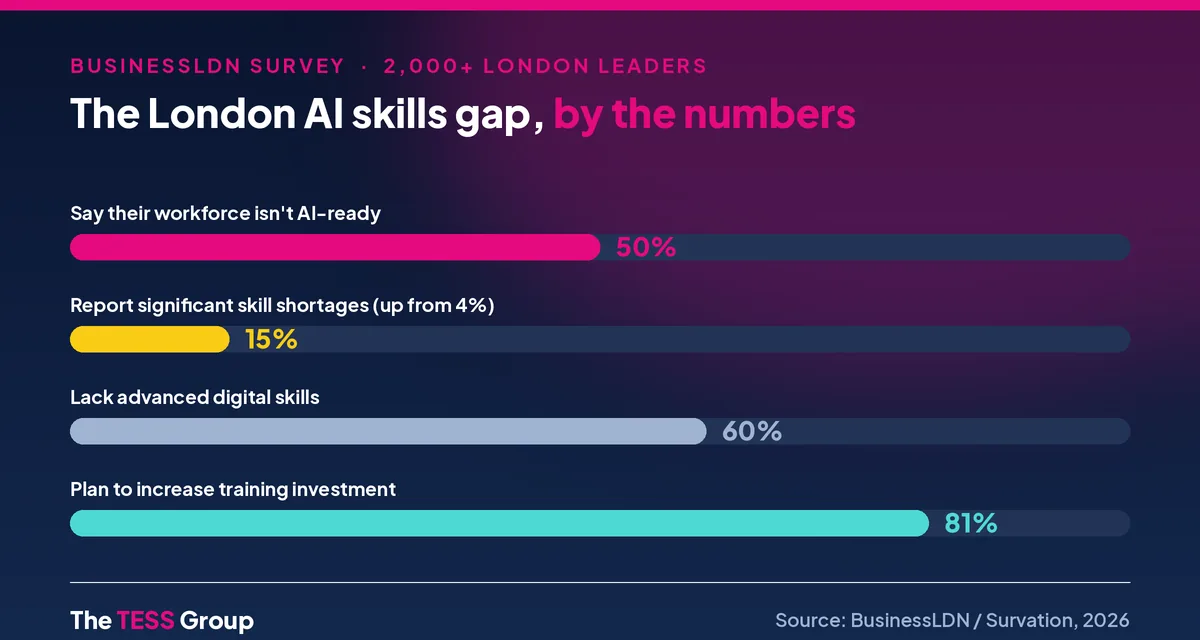
- One in two London businesses say their workforce is not equipped to meet their AI needs (down from 63%, but still half).
- Significant skill shortages jumped to 15%, from just 4% a year ago, the highest the survey has recorded.
- Among firms already using AI, 85% say it has changed the skills their workforce needs. The goalposts are moving.
- The encouraging part: 81% plan to increase training investment. Employers know what the fix is.
- In London's talent market, the firms that build capability internally will out-run the ones fighting to hire it.
There is a statistic doing the rounds this week that should make every employer pause: in a poll of more than 2,000 London business leaders, half said their workforce does not have the skills to meet their AI adoption needs. Not "could be better". Not ready. It is a blunt admission, and London is supposed to be the most AI-forward corner of the UK economy.
Read past the headline, though, and the same survey is quietly optimistic. Employers are not in denial, and they are not giving up. They are reaching for the obvious lever: training. The useful question is no longer "is there a gap?" (there is), it is "where do we put the training so it actually closes?"
What the survey actually found
The research, from BusinessLDN and conducted by Survation, polled more than 2,000 London business leaders. The top line: one in two say their people are not equipped for the organisation's AI requirements, down from 63% the year before, which sounds like progress until you look underneath. Significant skill shortages rose to 15%, up from just 4%, the highest since the survey began, and it is not only cutting-edge AI: 60% flagged a lack of advanced digital skills and 23% a lack of basic digital skills.
Is your team in the half that isn't AI-ready? We will map exactly which roles need training and how to fund it through the levy.
Map our skills gap →Why the gap is getting worse for some organisations
Here is the detail that explains it: among London firms already using AI, 85% said it had changed the skills their workforce needs, and three-quarters are already using AI in some form. The target keeps moving. AI is shifting from simple chatbots to agentic tools that act, things like Claude Tag and Copilot agents, which need people who can delegate to, supervise and govern them, not just write a prompt.
That is why occasional, ad-hoc training is losing the race. A one-off lunch-and-learn cannot keep pace with a capability that changes every few months. As one widely-quoted line from the sector put it, AI adoption becomes "a game of chance" when employees are left to navigate tools on their own. The organisations falling behind are not the ones doing nothing, they are the ones doing something once. The ones pulling ahead treat AI skills as an ongoing, structured programme, not an event.
Three-quarters of London firms already use AI. Half say their people are not ready for it. That gap is not a tooling problem, it is a training one.Lisa O'Reilly, Director, TESS Group
What closing the gap actually looks like
The fix is not exotic. It is matching the level of training to the role, then making it stick. Most of your organisation sits in the first tier.
Safe everyday AI use
Prompt well, know what not to put in, and check the output. Confident, safe daily use across the team.
AI governance & leadership
Decide where AI can act, what data it sees and how output is checked. Lead adoption, do not just authorise it.
Building automations & agents
Build the automations and agents that take real, repetitive work off the team, on your own processes.
The difference between this and a one-off course is accountability: a structured programme produces evidence that people can do the work, on your actual processes, not just a certificate of attendance. That is the gap between "we trained them" and "they can do it", which is the same distinction we drew in adoption is not ROI.
The London angle: build it faster than rivals can poach it
London is the most competitive talent market in the country, and that cuts two ways. Bidding for scarce, expensive AI hires is a race everyone is running and most will lose. The firms that come out ahead will be the ones that build the capability in the people they already have, faster than a competitor can poach it, and at a fraction of the cost. With 81% of London businesses planning to spend more on training, the ones who turn that spend into real, role-matched capability (rather than another round of awareness sessions) will pull away. Internal capability is also far stickier than a lateral hire who can be tempted across the river next quarter.
Current state vs what good looks like
AI tools bought, training ad-hoc. People muddle through, results are inconsistent, nobody checks the output, and the gap widens every time the tools change.
Training matched to role, on real work, with someone accountable for whether people can actually do the job. The gap closes, and stays closed as tools evolve.
And it is already funded
The reason this matters now: most employers do not need a new training budget to act. The Growth & Skills Levy already funds accredited AI apprenticeships. Levy-paying employers draw from a pot they are already contributing to; smaller non-levy employers have most or all of the cost met by government, with full funding for many under-25 starts from August 2026. So a large part of that 81% "more training" intent is, in effect, already sitting in the levy waiting to be used. The barrier is rarely money. It is choosing a structured route and starting.
Not just a London story
London is the one with the fresh survey, but the gap is national. The British Chambers of Commerce has warned that "Britain's workforce is not ready for what is coming", and demand runs through every sector we work in, from finance and professional services to manufacturing and the public sector. The reassuring counter-point in the data: 83% of these firms had vacancies and 76% did not expect to cut headcount, which cuts against the "AI is wiping out jobs" narrative. The work is not disappearing. It is changing, and so are the skills, the shift we covered in the new roles AI is creating.
Close your London team's AI skills gap with levy-funded training. Tell us where your biggest gaps are and we will send you a short, tailored recommendation: which roles to train, at what level, and how the levy covers it.
Get my tailored recommendation →Frequently asked questions.
What did the 2026 London AI skills survey find?
In a survey of more than 2,000 London business leaders by BusinessLDN (conducted by Survation), one in two said their workforce does not currently have the skills to meet their AI adoption needs. The share reporting significant skill shortages rose to 15%, up from 4% the year before, and 81% said they plan to increase training investment over the next year.
Why is the AI skills gap getting worse for some organisations?
AI is moving from simple chatbots to agentic tools that act, like Claude Tag and Copilot agents, and the skills needed are moving with it. Among London firms already using AI, 85% said it had changed the skills their workforce needs. Ad-hoc, one-off training cannot keep pace, so organisations that rely on it fall further behind while those running structured, ongoing programmes pull ahead.
Is training the answer to the AI skills gap?
London employers think so: 81% plan to increase training investment. The question is where it goes. Leaving staff to navigate AI tools alone produces inconsistent, unverified results. Structured training that builds applied skills and governance, on real work and matched to each role, is what turns a tool into measurable value.
How can a UK employer fund AI skills training?
Through the Growth and Skills Levy (the apprenticeship levy). Levy-paying employers draw from their levy pot, and smaller non-levy employers have most or all of the cost met by government, with full funding for many under-25 starts from August 2026. TESS Group's AI apprenticeships, from Level 3 to Level 6, are delivered on this funding.
Do staff need to be able to code to close the AI skills gap?
No. The survey points to a shortage of applied AI and digital skills across ordinary roles, not a shortage of programmers. The AI & Automation Practitioner Level 4 is a non-coding standard: it teaches people in HR, finance, operations and marketing to use AI and build automations on their own work, no programming required.
Where should a London employer start to close the gap?
Map which teams need which level of skill: most staff need confident, safe everyday use; managers need to govern AI; a smaller group needs to build automations and agents. Then put people on a funded route matched to that level. A short discovery call with TESS Group will map this and confirm what the levy covers.