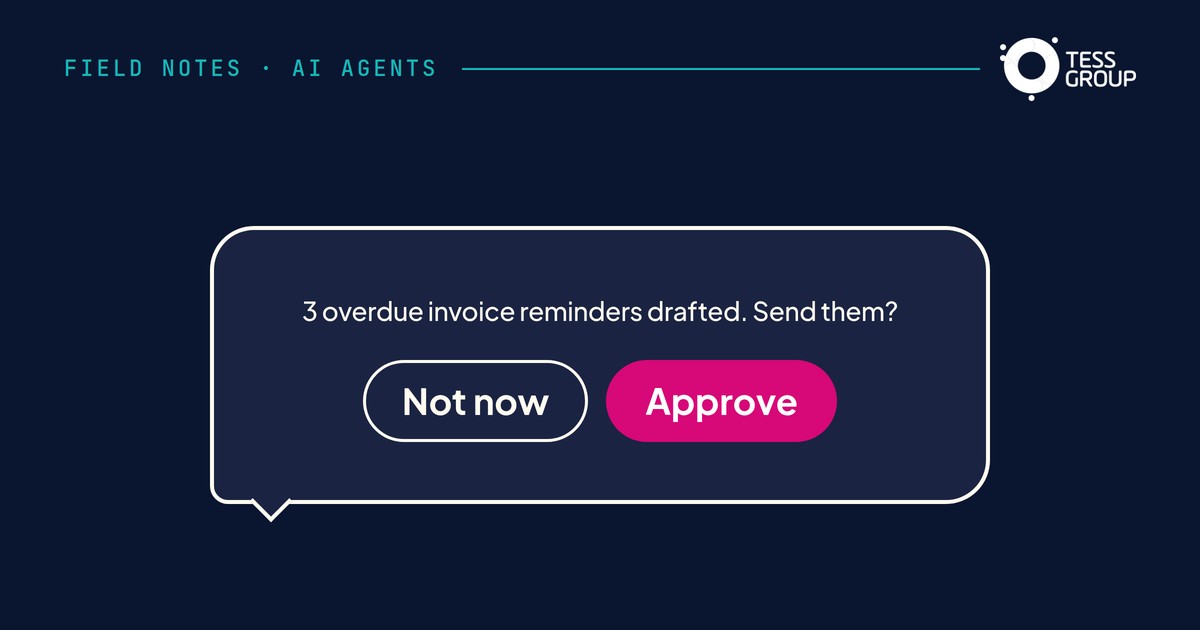
Picture someone in your finance team. Before nine o'clock, an agent has flagged three overdue invoices, drafted the reminders and is waiting for a decision. The valuable skill is no longer just writing a clever prompt. It is knowing whether to press send.
What Anthropic announced
On 21 October 2026, Anthropic announced Claude Duet, describing it in its launch post as "a new app where Claude works as a proactive agent. It comes to you with what needs your attention, completes tasks you ask of it, keeps working even when you step away, and checks with you before it acts on your behalf."
Duet sends a morning brief and works on its own virtual machine and browser, so your laptop need not be on. Anthropic's examples are everyday admin: checking QuickBooks or Stripe for unpaid invoices and drafting reminders, preparing payroll, and preparing agreements to send for signature. Before it sends, pays, signs or deletes anything, it shows you what it will do and waits for approval.
Anthropic's help centre says Duet is a research preview for Pro and Max subscribers in the US, through a waitlist, and not yet on Team or Enterprise plans. Anthropic admits it "still might misread a thread or miscalibrate what's urgent".
Not one launch, a pattern
In roughly ten weeks, several similar apps have launched:
- Grok Bot (11 August 2026) launched in beta: "AI teammates" with their own computer that come back when something needs approval.
- Muse, from Meta (8 September 2026), is a personal AI agent, rolling out in the US, that asks for approval before, say, sending an email or making a purchase.
- Dots, from OpenAI (29 September 2026), are "always-on agents" in ChatGPT with their own cloud computer.
CNBC placed Duet alongside Dots and Muse. The shape is shared: an agent with its own workspace that pauses for a human before anything consequential.
What agents ask of your team, and how the Level 4 apprenticeship builds it
When agents handle invoices, payroll and contracts, the approval step is the control that matters, and it is as strong as the person giving it. Anthropic advises users to "review drafts and approval requests before you confirm them". OpenAI says dots "can still make mistakes, so always review consequential work."
The Level 4 AI and Automation Practitioner apprenticeship (ST1512) is not tied to any app, but its Skills England standard maps closely onto what agents demand. The mapping below is ours; the KSB codes are from the standard (v2.1):
What proactive agents ask of your team
What the ST1512 standard covers (summarised)
At TESS, the apprenticeship is delivered live online for non-technical teams in every department, with no coding required. Apprentices practise in Coachy Labs without touching live employer systems, then map a real process, build a working automation and pilot it responsibly. As our Jobs Plan post argued, real change takes months of applying AI to your own job.
Illustrative example (not a real client). Sam, a credit controller, maps the overdue invoice process and decides which steps are safe to hand to AI: gathering account history and drafting reminders. Sam tests the instructions, builds a no-code workflow that prepares reminders, and sets one rule: nothing reaches a customer until Sam approves it. Each month Sam reports hours saved and drafts corrected. When an agent like Duet arrives, Sam already knows how to brief it and what to check.
Keep it in proportion
This is not a reason to panic. Duet is a research preview, not yet open in the UK, and each vendor acknowledges these agents make mistakes.
But this is not just a US story. At least one agent already reaches UK businesses on certain plans: OpenAI's help centre says Dots are available to ChatGPT Business Premium users across all supported regions, which include the UK, with access rolling out gradually.
Frequently asked questions.
What is Claude Duet?
A research preview app from Anthropic, announced 21 October 2026, where Claude works as a proactive agent and asks for approval before it sends, pays, signs or deletes anything.
Can UK businesses use Claude Duet yet?
Not yet. The research preview is open by waitlist to Pro and Max subscribers in the US.
How does the AI and Automation Practitioner Level 4 apprenticeship prepare staff for AI agents?
ST1512 covers process mapping, prompt design, human oversight, safe integration and measuring results, applied to a real process at work. In England it is funded from the apprenticeship levy or, for employers who do not pay the levy, by the government, with an employer contribution for apprentices aged 25 and over.
Sources: Anthropic, Introducing Claude Duet and Claude Help Center, 21 October 2026; OpenAI, Introducing dots and Help Center, 29 September 2026; Meta, Introducing Muse, 8 September 2026; x.ai, Introducing Grok Bot, 11 August 2026; CNBC, 21 October 2026; Skills England, ST1512 occupational standard v2.1. TESS Group has no partnership with, or endorsement from, any of the companies named.