In one year, the share of people in Japan who had used generative AI jumped from 26.7% to 58.8%. Yet more than a quarter of companies that allow it have no organised effort to change how work gets done with it. That gap, between using AI and reorganising around it, is what we brought back from Japan IT Week. On Friday 23 October, the two of us, Rod Doyle and Lisa O'Reilly, spent the day with the TESS team at Japan IT Week and Japan DX & AX Week (Autumn 2026) at Makuhari Messe, just east of Tokyo.
What is AX? AX, or AI transformation, is the term Japan's second AI Basic Plan uses for organisations "redesigning decision-making and ways of working with AI at the core". The show's organisers pair it with DX, digital transformation.
We set out why we went in An AI curriculum written in January is out of date by June. This is what we brought home. The full employer debrief follows the week of 2 November.
What this means for a UK employer, in 30 seconds
- Using AI is not the same as changing how work gets done. In Japan, 86.4% of companies use generative AI somewhere, but 27.0% of those that allow it have no organised effort to redesign work around it.
- Most are still at the thinking stage. In Mitsubishi Research Institute's survey, 75.9% were considering designing work around AI and 10.1% had done it.
- The gap is skills and confidence, not tools. Treat AI skills as something to build across the whole workforce, through upskilling and apprenticeships, including the AI & Automation Practitioner Level 4 apprenticeship, not as a job for the IT team alone.
Why is Japan pushing AI so hard?
Japan has a long habit of setting national goals for technology. Society 5.0, originally proposed in the government's 2016 science and technology plan, describes a human-centred society that joins up cyberspace and the physical world. AI is the latest chapter, and demography is driving it. In 2023, Recruit Works Institute projected a shortfall of more than 11 million workers by 2040, with the working-age population expected to fall by a fifth from 2020.
Adoption started late but is now moving fast. In the government's 2026 Information and Communications White Paper, 58.8% of people in Japan said they had used generative AI, up from 26.7% a year earlier, though still behind the US and Germany (both 75.6%) and China (93.6%). Among companies, 86.4% were using generative AI in some part of their work. Yet 27.0% said they had no organised effort to change how work is done with it, a notably higher share than in the other three countries. Fast adoption, slow organisational change.
The government has responded with law and a plan. The AI Promotion Act was passed on 28 May 2025 and came fully into force on 1 September 2025. The government's second AI Basic Plan, approved by the Cabinet on 14 July 2026, is subtitled "Japan AI Transformation: A Stronger Nation. Greater Prosperity." It describes AI "evolving from a tool that supports human work into an agent capable of making decisions and taking actions". It argues that labour shortages make AX, starting with agentic AI, especially valuable. It also commits to reskilling and AI literacy, and to building human strengths such as critical thinking, judgement and accountability for decisions. And it will be updated every year for the foreseeable future.
What was the big theme at Japan IT Week 2026?
The organisers put this shift at the front of their pitch. Their launch release said company AI use is widening from supporting individual tasks to supporting organisational decisions and getting the work done, and it pointed to the July AI Basic Plan and to labour shortages. One independent tally of the organisers' exhibitor search, published a few days before the show, counted 130 exhibitors listing "AI agents" as a product category, more than any other AI category.
The 23 October programme carried the same message. A panel of IBM Japan, Fujitsu and Hitachi asked how software development changes in the age of AI agents. A session from Digirise, a Japanese AI training firm, was titled, in our translation, "The order of adoption for filling labour shortages with AI agents, without failing". Its summary put the problem in one line:
"The cause is not the tool, but which work you hand over, and in what order."
Digirise session summary, Japan IT Week programme (our translation)
What we saw on the floor
- We saw the open "Claude Code practical course" (Claude Code実践講座).
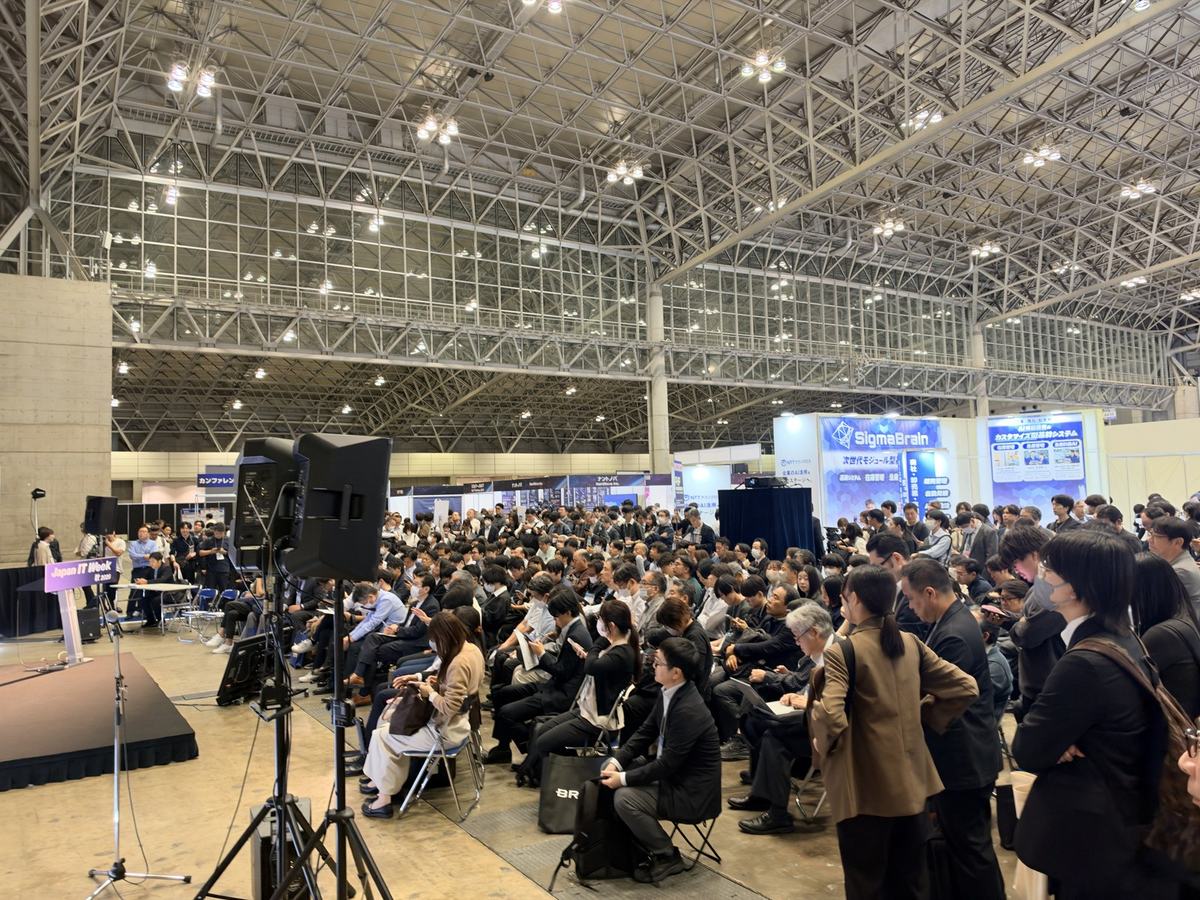
- We watched a packed seminar session.
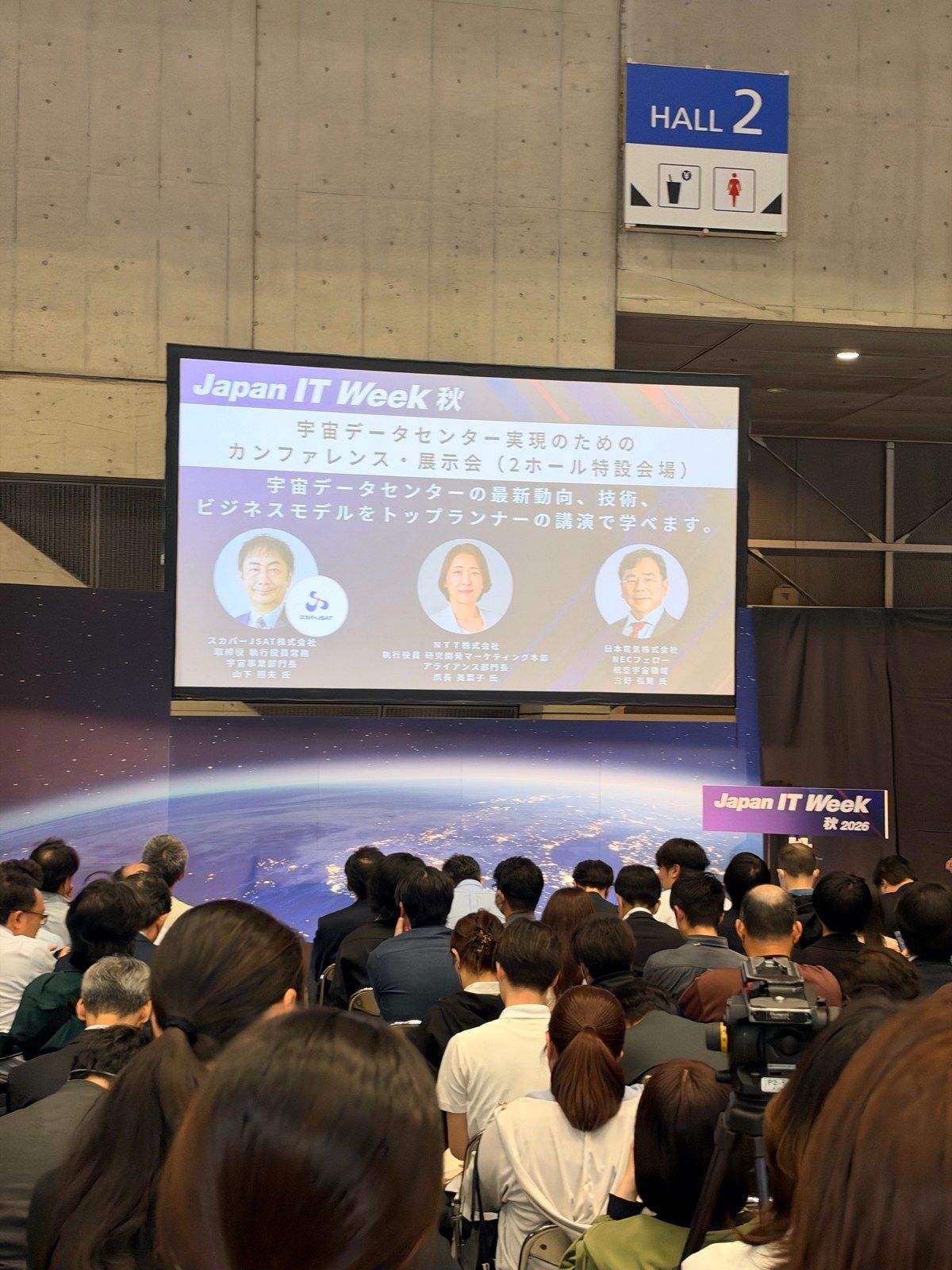
- We went to a conference session on data centres in space, in the organisers' special Hall 2 feature, with speakers from SKY Perfect JSAT, NTT and NEC.

Elsewhere on the 23 October programme
These come from the published programme; we could not be everywhere at once.
- Mitsubishi Research Institute, on "AI-first management", drawing on the survey above.
- Nippon Ham, on moving beyond AI pilot projects.
- Fujifilm Business Innovation's CTO, on making a company's own knowledge usable by AI.
- Japan's AI Safety Institute, on what makes AI trustworthy.
What should UK employers take from Japan?
Japan's starting point is different from ours. It has fewer workers coming through, and its companies are adopting AI faster than they are reorganising around it. But the bottleneck looks the same. The tools are arriving quickly. What holds organisations back is people who can decide what to hand to AI, check what comes back and own the decision. Japan's own plan puts accountability for decisions at the centre, and the programme pointed the same way: a practical Claude Code course, sessions on moving beyond pilots and a session on trustworthy AI all assume people who can use the tools and judge what they produce.
Here is what we think UK employers can take from it:
- Start with the work, not the tool. Map the tasks, then choose what to hand to AI and in what order.
- Build skills beyond the IT team. The people closest to the work are best placed to redesign it.
- Give leaders the judgement to govern it. Trust, risk and accountability are leadership decisions.
- Plan for constant change. Japan has committed to updating its AI plan every year. Skills need the same rhythm.
Quick answers
- What is Japan's second AI Basic Plan? A government plan approved by the Cabinet on 14 July 2026, subtitled "Japan AI Transformation: A Stronger Nation. Greater Prosperity." It will be updated every year for the foreseeable future.
- How many people in Japan have used generative AI? 58.8% said they had used it in the government's 2026 White Paper survey, up from 26.7% a year earlier, against 75.6% in the US and Germany and 93.6% in China.
- Why is Japan focused on AI agents? Labour shortages. In 2023, Recruit Works Institute projected a shortfall of more than 11 million workers by 2040, and the plan argues this makes AX, starting with agentic AI, especially valuable.
How TESS can help
Japan's lesson is to start with the work, not the tool. If you'd like help working out which tasks in your organisation to hand to AI, and who needs the skills to check the results, book a conversation with us. We do this through the AI & Automation Practitioner Level 4 apprenticeship for practical, responsible AI skills in non-technical teams, and short Level 5 AI leadership units for the senior leaders who decide how AI is used.
Rod Doyle, Co-founder & Director, and Lisa O'Reilly, Director, The TESS Group