Key takeaways
- Claude Opus 5 launched on 24 July 2026, now the default on Claude Max and the top model on Claude Pro.
- It delivers roughly Fable-level intelligence at half the price: $5 / $25 per million tokens versus Fable 5's $10 / $50.
- It adds an effort dial (low to xhigh) and Fast mode, keeps the 1M-token context window, and is built for everyday professional work.
- Early testers found it breaks old workflows. Those who rebuilt from scratch and used lower effort got dramatically better results.
- The bottom line: when frontier capability is cheap and one click away, the differentiator is no longer the model. It is whether your people know how to drive it.
On Friday, Anthropic released Claude Opus 5, its newest flagship. On the company's own benchmarks it reaches roughly Claude Fable 5-level intelligence at half the price, and it is built for the everyday professional work most businesses actually do.
But the most useful thing about this launch is not the benchmark scores. It is what the earliest users found within hours: Opus 5 is powerful and a little temperamental, and the people getting the most from it are the ones who changed how they work. When capability gets this cheap and this available, the gap between businesses stops being about access and starts being about skill.
That has a practical consequence we will come back to at the end: if the differentiator is skill, then AI capability becomes a training decision rather than a procurement one, and in the UK it is one the apprenticeship levy already funds through routes like our Claude AI Apprenticeship. First, what actually launched.
What Claude Opus 5 actually delivers
Half the price of Fable 5
Opus 5 costs $5 per million input tokens and $25 per million output, the same as Opus 4.8, against Fable 5's $10 / $50. That is frontier-level output at a mid-range price, and it is the single biggest practical change for anyone running AI at volume.
| Claude Opus 5 | Claude Fable 5 | Claude Opus 4.8 | |
|---|---|---|---|
| Price per million tokens | $5 in / $25 out | $10 in / $50 out | $5 in / $25 out |
| Best used for | Everyday professional work | Longest, hardest autonomous tasks | The previous everyday model |
| Who should use it | Most teams, most of the time | Specialists running long, complex jobs | Anyone on stable workflows built around it |
| Effort dial | Yes (low to xhigh) | Not offered | Not offered |
| Availability | Default on Max, top model on Pro | Available via usage credits | Still available, and the fallback when a request is blocked |
Anthropic's published launch figures, 24 July 2026. Opus 5 matches Opus 4.8 on price while roughly doubling its score on agentic terminal coding. Pricing and positioning change quickly.
An effort dial, and what it is for
You now choose low, medium, high or xhigh reasoning effort per prompt, trading cost and speed against depth. A Fast mode runs about 2.5 times quicker for double the base price. This is the feature most people will under-use, and the one that most rewards knowing what you are doing. Choosing the right effort level for a given job is one of the first practical skills we teach on the Level 4 Claude apprenticeship.
Where it leads, and where it doesn't
On the benchmarks that map to real business work, Opus 5 leads:
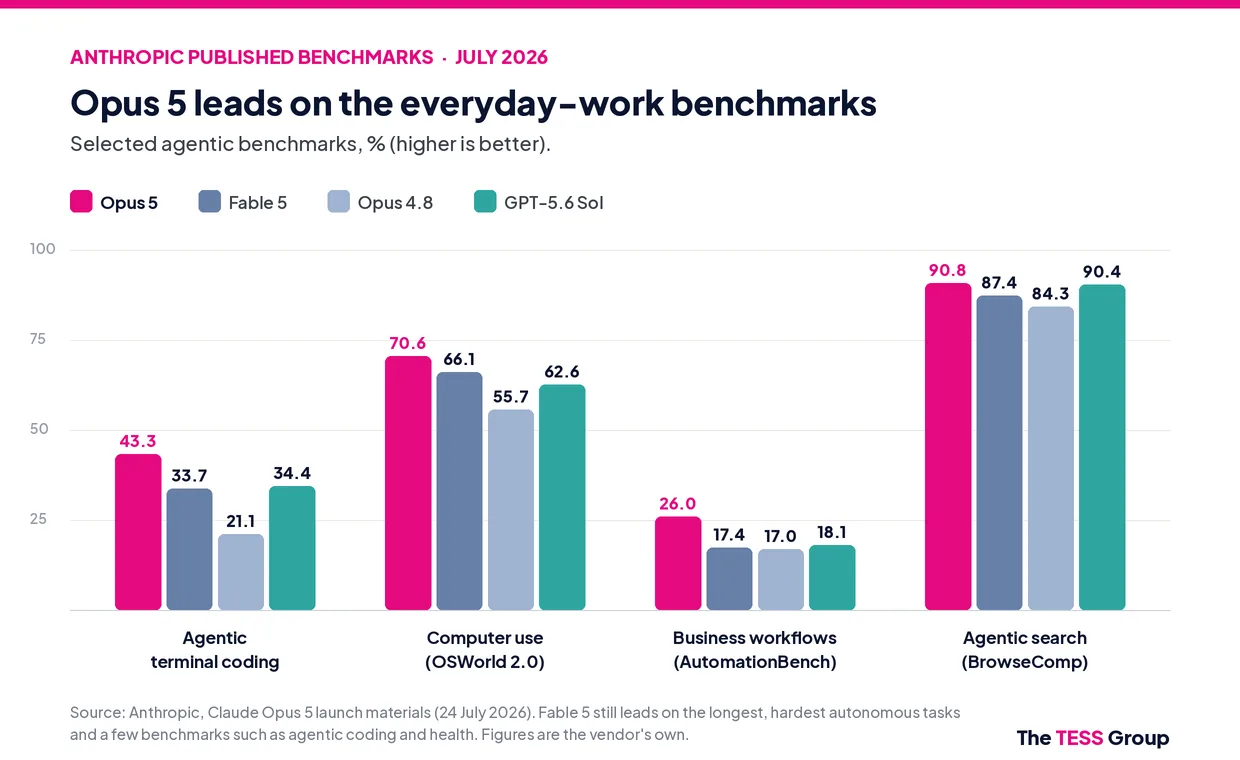
Two early customers put numbers on it. The legal-AI firm Harvey reported Opus 5 matching the output quality of Opus 4.8 at maximum reasoning while cutting token usage by 26%. Zapier's chief executive said it completed a full churn-prevention workflow end to end on the AutomationBench test, a task earlier models had failed, without using more tokens. Anthropic also says Opus 5 scored better on its internal alignment audit than any prior model.
To be balanced: this is not a clean sweep. Anthropic itself says Fable 5 remains stronger for the longest, hardest autonomous tasks, and Fable or GPT-5.6 still edge Opus 5 on a couple of coding and health benchmarks. Opus 5 is the better everyday model, not the undisputed best at everything.
The catch, and why skills now decide the winners
Here is where it gets interesting for anyone who has to use this at work. The day-0 reviews were not uniformly glowing. Writing on Every, its chief executive Dan Shipper published a day-0 review after a week of testing across coding, writing, knowledge work and an internal agent. He called it "a hard model to love", and flagged two things every business should note:
- It breaks backward compatibility. Dropped into workflows and custom skills built for earlier models, Opus 5 would often stop early or miss instructions. His first reaction: "What have they done to my boy?"
- Starting fresh, and using less effort, worked far better. When his team deleted their old skills and rebuilt from scratch, and dialled the reasoning effort down, Opus 5 "got dramatically better, and even showed flashes of brilliance".
Read that again, because it is the real story of this launch. The model did not get worse. The old ways of working stopped fitting it. The people who won were the ones who understood it well enough to change their approach.
Every model launch used to be about who has the best model. Opus 5 makes it obvious that the real question is who can actually get the best out of it. The same model gives one team brilliance and another team frustration, and the only variable is skill. Rod Doyle, Director, TESS Group
What skilled users are doing differently with Opus 5
This is the practical bit. Four habits separate people getting brilliance from people getting frustration, and all four are learnable in an afternoon of good practice:
- Start important tasks in a fresh conversation. Not a thread carrying system prompts and instructions written for an older model. Legacy scaffolding is the single most common cause of Opus 5 stopping early.
- Dial effort down for everyday work. Reach for high or xhigh only when the task genuinely needs depth. Counter-intuitively, more thinking time can produce more of the annoying behaviours, so low or medium is often cleaner for routine work.
- Rebuild old skills and workflows from scratch. Do not force the new model into last year's patterns. Rebuilding takes time, but it is where the payoff sits.
- Make it critique its own first draft. Ask the model to review and improve its output against your criteria before you accept it. This one habit lifts quality more than any prompt trick, and it is a core part of how we teach output quality on our Claude edition of the Level 4.
None of that is exotic. It is the difference between someone who has used a model for a fortnight and someone who has been taught how these systems behave, which is precisely the kind of judgement that is now worth money. Those four habits are, almost exactly, the working practices our Claude AI Apprenticeship drills into apprentices over their first months.
What this means for UK businesses
The gap between businesses is no longer about who can access the best model. Opus 5 is a click away for anyone on Claude Pro or Max, and it is cheaper than what came before. The gap is about who can use it well, and it widens with every release.
- Capability is getting cheaper, so value moves to skill. Frontier output at half last month's price only helps if your people turn it into finished work.
- The effort dial is a skill, not a setting. Knowing when low beats high, and when to reach for a different model entirely, is judgement.
- Workflows need people who can rebuild them. Models will keep changing under your processes. The asset is the person who can re-point a workflow in an afternoon, which is the capability a levy-funded Claude apprenticeship is designed to produce.
Which raises the obvious question: if skill is the differentiator, how do you build it in more than one or two people? That is a training decision, and it is the one part of this whole story you can actually control.
How organisations close the skill gap at scale
One or two self-taught enthusiasts is where most businesses are now. The problem is that their skill does not spread on its own, and it walks out of the door if they leave. Turning individual knack into team capability is a training problem, and in the UK it is one the levy already pays for.
Practitioner level: build people who do the work
The AI & Automation Practitioner Level 4 (standard ST1512), which we also deliver as a dedicated Claude edition of the AI & Automation Practitioner, builds exactly the habits above: prompting well, choosing the right effort level, designing and rebuilding workflows, and governing the output. It is fully funded through the Growth & Skills Levy and needs no coding background to start.
Three things make that credible rather than a claim. We don't teach last year's model: learners practise on the model that launched this week. Coachy, our 24/7 AI tutor, is itself built on Claude, so learners on the Claude apprenticeship practise on the same family of models they will use at work. And a launch like Opus 5 is not a disruption to a cohort, it is next week's lesson.
Leadership level: set direction and guardrails
For leaders, the questions are different: when to adopt, how to standardise good practice, how to govern it. Our short AI Leadership units are Skills England Level 5, 30 guided hours each and £750 per learner, funded through the levy, with no end-point assessment. A release like this is a live case study in AI Strategy and Opportunity and AI Adoption, Procurement and Governance.
Employers do not need their team trained on last year's tools. We teach on what is genuinely current, so when a model like Opus 5 lands, our apprentices are already working with it while everyone else is still reading the launch blog. Lisa O'Reilly, Director, TESS Group
What to do this week
- Try Opus 5 on real work. If you are on Claude Pro or Max it is already there. Start fresh rather than reusing an old workflow, and experiment with the effort dial.
- Notice who gets good results. That instinct is a skill, and it can be taught to everyone else, which is exactly what the Claude AI Apprenticeship is built to do.
- Pick the first roles to train. Usually the people closest to repetitive, high-volume process work.
- Fund the skill, not just the licence. A levy-funded apprenticeship turns one or two capable users into a whole team that can work with whatever launches next. See the Claude AI Apprenticeship for the Claude-specific route.
Want your team practising on Opus 5 rather than reading about it? See the Claude AI Apprenticeship (Level 4), or the broader AI & Automation Practitioner. Levy-funded, no coding needed to start.
For leaders setting direction and governance around models like this, see the AI Leadership units, 30 hours, £750 per learner, funded.
Book a 30-minute call to map which roles start first →Benchmarks and prices are Anthropic's own launch figures and reflect the position at the time of writing; model rankings and pricing change quickly. Early-user impressions are attributed to their authors. Claude Opus 5 launched on 24 July 2026 as claude-opus-5.
Frequently asked questions.
What is Claude Opus 5?
Claude Opus 5 is Anthropic's newest flagship model, launched on 24 July 2026. It offers roughly Claude Fable 5-level intelligence at half the price, with a one-million-token context window and an effort dial that lets you trade cost for capability per request. It is now the default on Claude Max and the top option on Claude Pro, and is available to developers as claude-opus-5.
How much does Claude Opus 5 cost?
Opus 5 is priced at $5 per million input tokens and $25 per million output tokens, the same as Opus 4.8, and half the price of Fable 5 ($10 / $50). A Fast mode runs at about 2.5 times the standard speed for double the base price, and the effort dial lets you dial output quality down for faster, cheaper responses.
Is Claude Opus 5 better than Fable 5 or GPT-5.6?
On Anthropic's figures, Opus 5 sets new highs on everyday-work benchmarks such as terminal coding, computer use and business workflows, and leads the field on several. Anthropic positions it for daily professional work rather than the longest autonomous tasks, for which it says Fable 5 remains stronger, and Fable still leads a few benchmarks. In short, Opus 5 is a better everyday model, not a clear winner on every measure.
What is the effort dial in Opus 5?
Opus 5 has a reasoning-effort setting (low, medium, high or xhigh) that you choose per prompt, trading cost and speed against depth of reasoning. Early users have found that lower effort often produces cleaner results for everyday tasks, so knowing which setting to use is part of getting good output, which is a learnable skill rather than a fixed feature.
Why do early reviews say Opus 5 is hard to work with?
Some early testers, including Dan Shipper of Every, found Opus 5 breaks backward compatibility: used with workflows and skills built for earlier models it can stop early or miss instructions. The same testers found that starting from scratch, and using lower effort settings, produced dramatically better results. That makes it a model that rewards people who know how to work with it, rather than one you can drop in unchanged.
Is Claude Opus 5 better than Fable 5 for everyday work?
For most everyday professional work, yes. Anthropic positions Opus 5 for daily professional tasks and it leads Fable 5 on benchmarks such as agentic terminal coding (43.3% vs 33.7%), computer use (70.6% vs 66.1%) and business workflows (26.0% vs 17.4%), at half the price. Anthropic says Fable 5 remains the stronger choice for the longest, hardest autonomous tasks, so the sensible pattern is Opus 5 for daily work and Fable 5 for the occasional deep job.
How do I get better results from Claude Opus 5?
Four things work for early users. Start important tasks in a fresh conversation rather than reusing system prompts built for older models. Use lower effort settings for everyday work and save high or xhigh for genuinely deep tasks. Rebuild old custom skills and workflows from scratch instead of forcing Opus 5 into previous patterns. And ask the model to critique and improve its own first draft before you accept the output.
Can I fund Claude or AI skills training through the apprenticeship levy?
Yes. AI apprenticeships such as the AI & Automation Practitioner Level 4 are funded through the Growth and Skills Levy, so levy-paying employers can spend their existing levy funds on them, and training is government-funded for under-25s at non-levy employers from August 2026. Short Level 5 AI Leadership units are funded at £750 per learner per unit.
How quickly can a team get productive on Opus 5?
Individuals can get useful results in days by starting fresh conversations, using lower effort settings for routine work and asking the model to critique its own drafts. Turning that into dependable team capability, where people can rebuild workflows and govern the output, typically takes structured training over months rather than a lunchtime demo. That is the gap a Level 4 apprenticeship is designed to close, alongside the day job.
Does TESS Group teach Claude Opus 5?
Yes. Our Claude Apprenticeship and AI & Automation Practitioner Level 4 teach people to get real work done with the current Claude models, including Opus 5: prompting well, choosing the right effort level, designing and rebuilding workflows, and governing the result. We built our own AI tutor, Coachy, on Claude, so we teach from live practice, not theory.
Sources
Anthropic, Claude Opus 5 launch materials (24 July 2026). Reporting: Quartz, TechCrunch (Claude voice mode), and CNBC. Early-user impressions: Dan Shipper, Every. Figures are the vendor's own and change quickly.