On 22 October, the BBC reported that Barclays is cutting around 5,000 staff as it introduces more AI into its work processes. The bank said 1,000 posts had already closed and it expects a further 4,000 to go by the end of the year, around 5% of its global workforce. Around 60% of the cuts will fall within its support functions.
It is worth being fair here. The BBC notes that not all of the cuts are due to AI, and Barclays describes them as part of an ongoing modernisation plan. Its chief executive, CS Venkatakrishnan, said: "AI is the icing on the cake not the cake. Because you need to do the infrastructure build to get the benefits of AI."
I actually agree with him on that point. But it raises a question every employer should be asking: if AI is going to change the support roles in your business, what is the plan for the people in them?
Why support roles feel it first
Support functions are full of the work AI is good at: moving data between systems, checking documents, drafting routine replies, building reports. The BBC piece notes that companies are spending more on AI, along with claims that new tools can replace some of the basic tasks staff do, such as administrative and programming work.
That is exactly why these teams are worth investing in. The people doing that work today know your processes, your customers and your systems better than anyone. They know where the workarounds are and why they exist. That knowledge takes years to build, and you lose it the day someone walks out of the door.
The case for reskilling, not replacing
Sharon Graham of Unite put the alternative plainly in the same BBC report:
"Employers should be focussed on upgrading employees' skills so that they remain employed as new technology changes the workplace."
Sharon Graham, General Secretary, Unite, BBC News, 22 October 2026
You do not have to share every view of a trade union to see the sense in that. Reskilling is often the more practical route for an employer, too. Recruiting is slow and expensive, new starters take months to get up to speed, and a team that has just watched colleagues leave is rarely at its most productive.
AI reskilling for employees changes the question from "which roles can we remove?" to "what could this team do if the repetitive work was automated?" In my experience, the answer is usually a lot. The admin lead who knows every step of the month-end process is the best person to automate it, because they know where it goes wrong.
A low-risk first step: a workshop or taster day
You do not need to commit to a big programme to find out whether this works for your team. Start small.
A focused workshop. Colart's HR team is a good example. They had Microsoft Copilot, but use was cautious and inconsistent. A half-day workshop with us gave the team a shared, structured way of prompting, practical techniques mapped to real HR tasks, and clear guardrails, with a person always making the final call. Their case study puts it simply: "We have Copilot" became "our HR team genuinely gets value from it".
A hands-on taster day. Our next complimentary AI Automation Taster Day is on Wednesday 2 December, live online, 9.30am to 3.30pm. People bring one real, repetitive process from their job and leave with it automated. No coding is needed, and no-cost plans on the build platforms are fine. It is a quick way to see who in your support team has the appetite to go further.
Then build it properly
A workshop builds momentum. Lasting capability comes from structured development, and that is where an apprenticeship comes in.
Here is a simple plan I would suggest to any employer worried about AI and their support teams:
A four-step plan for your support teams
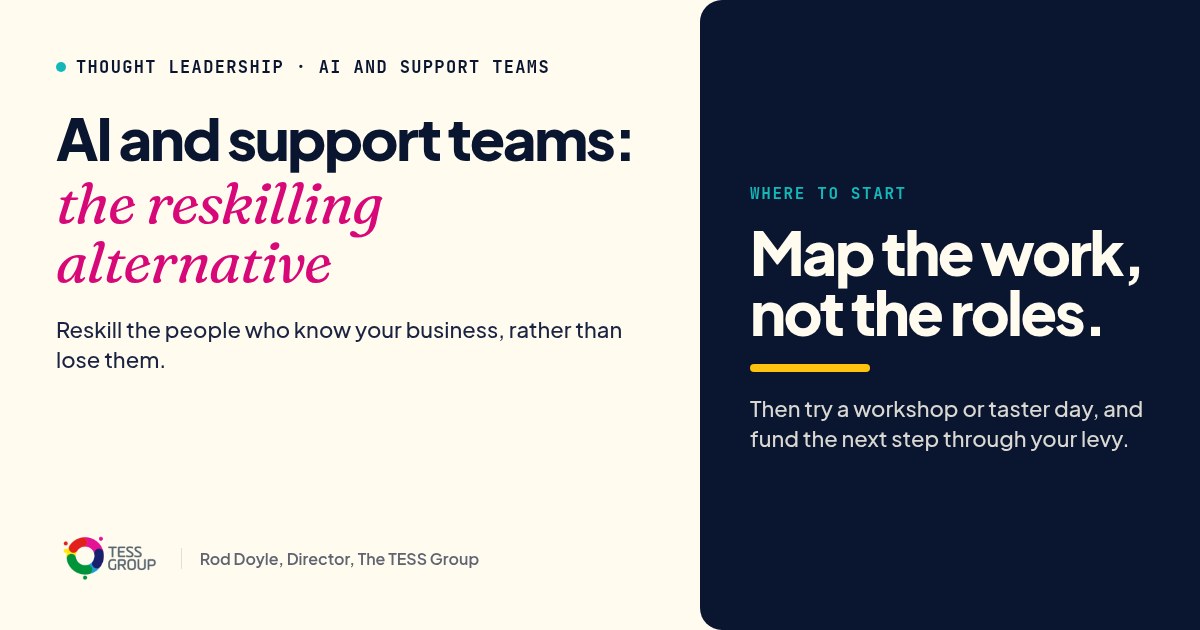
- Map the work, not the roles. List the tasks that eat time each week and could be automated.
- Ask for volunteers. The people who are curious about AI will often surprise you.
- Try a workshop or taster day. Low commitment, quick feedback.
- Fund the next step. Put your most engaged people on an accredited programme, paid for through your levy where you can.
How TESS can help
We are a specialist AI apprenticeship provider, rated Good by Ofsted, and the programme I would point most support teams to is the AI & Automation Practitioner Level 4 apprenticeship (ST1512). It is designed for non-technical people across every department, including administration, finance, HR and operations, with no coding required. Over 12 months of live online learning, 15 months in all, apprentices build working automations and AI agents in your business, with up to five qualifications and Coachy, our 24/7 AI tutor. It can be funded from your levy, or by the government for apprentices aged 16 to 24. For your senior leaders, our Level 5 AI Leadership Units cover strategy, governance and delivery in 30 hours each.
If you would rather reskill the people who know your business than lose them, book a 30-minute call with me and we will work out a sensible first step together.
Rod Doyle, Director, The TESS Group
Sources
Checked 26 October 2026.